Ch. 11 - Power Series
Briggs - Calculus: Early Transcendentals 3rd Edition
Briggs3rd EditionCalculus: Early TranscendentalsISBN: 9780136847243Not the one you use?Change textbook
Chapter 11, Problem 11.3.5

Suppose you know the Maclaurin series for f and that it converges to f(x) for |x|<1. How do you find the Maclaurin series for f(x²) and where does it converge?

Verified step by step guidance
1
Recall that the Maclaurin series for a function \(f(x)\) is given by \(f(x) = \sum_{n=0}^{\infty} a_n x^n\), where \(a_n = \frac{f^{(n)}(0)}{n!}\) and the series converges for \(|x| < 1\).
To find the Maclaurin series for \(f(x^2)\), substitute \(x^2\) in place of \(x\) in the original series. This gives \(f(x^2) = \sum_{n=0}^{\infty} a_n (x^2)^n\).
Simplify the powers: \((x^2)^n = x^{2n}\), so the series becomes \(f(x^2) = \sum_{n=0}^{\infty} a_n x^{2n}\).
Analyze the radius of convergence for the new series. Since the original series converges for \(|x| < 1\), the substitution \(x^2\) means the new series converges when \(|x^2| < 1\), which simplifies to \(|x| < 1\).
Therefore, the Maclaurin series for \(f(x^2)\) is \(\sum_{n=0}^{\infty} a_n x^{2n}\), and it converges for \(|x| < 1\).

Verified video answer for a similar problem:

This video solution was recommended by our tutors as helpful for the problem above.
Video duration:
2m
Was this helpful?

Key Concepts

Here are the essential concepts you must grasp in order to answer the question correctly.

Maclaurin Series

A Maclaurin series is a Taylor series expansion of a function about zero, expressed as an infinite sum of terms involving derivatives of the function at zero. It represents the function as f(x) = Σ (f⁽ⁿ⁾(0)/n!) xⁿ, valid within its radius of convergence.
Recommended video:
08:26
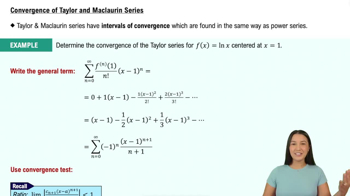
Convergence of Taylor & Maclaurin Series

Substitution in Power Series

To find the Maclaurin series for f(x²), substitute x² in place of x in the original series. This changes each term xⁿ to (x²)ⁿ = x^(2n), effectively altering the powers and coefficients but preserving the series structure.
Recommended video:
05:58
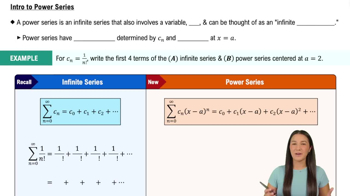
Intro to Power Series

Radius of Convergence

The radius of convergence defines the interval where the power series converges to the function. For f(x²), the convergence depends on |x²| < 1, which implies |x| < 1, so the radius of convergence remains the same as the original series.
Recommended video:
07:36
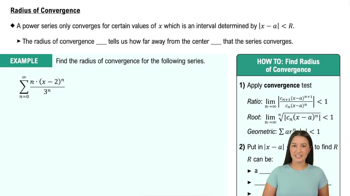
Radius of Convergence
Related Practice
Textbook Question

Radius and interval of convergence Determine the radius and interval of convergence of the following power series.


∑ₖ₌₀∞ (2x)ᵏ

Textbook Question

{Use of Tech} A different kind of approximation When approximating a function f using a Taylor polynomial, we use information about f and its derivative at one point. An alternative approach (called interpolation) uses information about f at several different points. Suppose we wish to approximate f(x)=sin x on the interval [0, π].


a. Write the (quadratic) Taylor polynomial p₂ for f centered at π/2.


b. Now consider a quadratic interpolating polynomial q(x) = ax² + bx + c. The coefficients a, b, and c are chosen such that the following conditions are satisfied:

q(0) = f(0), q(π/2) = f(π/2), and q(π) = f(π)


Show that q(x) = −(4/π²)x² + (4/π)x.


c. Graph f, p₂, and q on [0, π].


d. Find the error in approximating f(x) = sin x at the points π/4, π/2, 3π/4, and π using p₂ and q.


e. Which function, p₂ or q, is a better approximation to f on [0, π]? Explain.

Textbook Question

{Use of Tech} Estimating errors Use the remainder to find a bound on the error in approximating the following quantities with the nth-order Taylor polynomial centered at 0. Estimates are not unique.


ln 1.04, n=3

Textbook Question

{Use of Tech} Estimating errors Use the remainder to find a bound on the error in approximating the following quantities with the nth-order Taylor polynomial centered at 0. Estimates are not unique.


sin 0.3, n = 4

Textbook Question

Radius and interval of convergence Determine the radius and interval of convergence of the following power series.


∑ₖ₌₂∞ ((x+3)ᵏ)/(k łn²k)

1
views
Textbook Question

Any method


a. Use any analytical method to find the first four nonzero terms of the Taylor series centered at 0 for the following functions. You do not need to use the definition of the Taylor series coefficients.


b. Determine the radius of convergence of the series.


f(x) = (1 + x²)⁻²/³