
Ch. 11 - Power Series
Briggs - Calculus: Early Transcendentals 3rd Edition
Briggs3rd EditionCalculus: Early TranscendentalsISBN: 9780136847243Not the one you use?Change textbook
Chapter 11, Problem 11.2.6

Suppose a power series converges if |x−3|<4 and diverges if |x−3| ≥ 4. Determine the radius and interval of convergence.

Verified step by step guidance
1
Identify the center of the power series from the given inequality. Here, the series converges when \(|x - 3| < 4\), so the center is at \(x = 3\).
Recall that the radius of convergence \(R\) is the distance from the center to the boundary of convergence. Since the series converges for \(|x - 3| < 4\), the radius of convergence is \(R = 4\).
To find the interval of convergence, write the inequality \(|x - 3| < 4\) as a double inequality: \(-4 < x - 3 < 4\).
Add 3 to all parts of the inequality to isolate \(x\): \(-4 + 3 < x < 4 + 3\), which simplifies to \(-1 < x < 7\).
The interval of convergence is therefore \(( -1, 7 )\). To fully determine the interval, you would check convergence at the endpoints \(x = -1\) and \(x = 7\) separately, but based on the problem statement, the series diverges when \(|x - 3| \geq 4\), so the endpoints are not included.

Verified video answer for a similar problem:

This video solution was recommended by our tutors as helpful for the problem above.
Video duration:
2m
Was this helpful?

Key Concepts

Here are the essential concepts you must grasp in order to answer the question correctly.

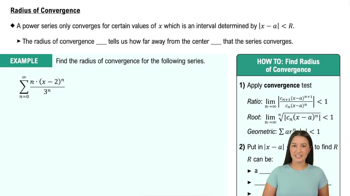
Radius of Convergence

The radius of convergence is the distance from the center of a power series within which the series converges. It is found by identifying the boundary where the series changes from convergence to divergence, often expressed as |x - c| < R, where c is the center and R is the radius.
Recommended video:
07:36
Radius of Convergence

Interval of Convergence

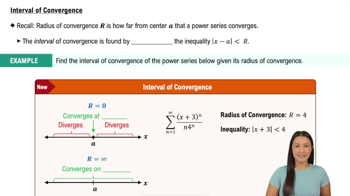
The interval of convergence is the set of all x-values for which the power series converges. It is centered at c and extends R units in both directions, typically written as (c - R, c + R), but endpoints must be tested separately for convergence or divergence.
Recommended video:
08:44
Interval of Convergence

Power Series Convergence Tests

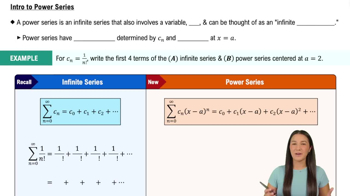
To determine where a power series converges or diverges, tests like the Ratio Test or Root Test are used. These tests help find the radius of convergence and check endpoint behavior, which is crucial for establishing the exact interval of convergence.
Recommended video:
05:58
Intro to Power Series
Related Practice
Textbook Question

{Use of Tech} Approximations with Taylor polynomials


a. Approximate the given quantities using Taylor polynomials with n = 3.


b. Compute the absolute error in the approximation, assuming the exact value is given by a calculator.


e⁰ᐧ¹²

Textbook Question

Differentiating and integrating power series Find the power series representation for g centered at 0 by differentiating or integrating the power series for f (perhaps more than once). Give the interval of convergence for the resulting series.


g(x) = − 1/(1 + x)² using f(x) = 1/(1 + x)

Textbook Question

Limits Evaluate the following limits using Taylor series.

lim ₓ→₀ (sin 2x)/x

Textbook Question

Derivative trick Here is an alternative way to evaluate higher derivatives of a function f that may save time. Suppose you can find the Taylor series for f centered at the point a without evaluating derivatives (for example, from a known series). Then f⁽ᵏ⁾(a)=k! multiplied by the coefficient of (x−a)ᵏ. Use this idea to evaluate f⁽³⁾(0) and f⁽⁴⁾(0) for the following functions. Use known series and do not evaluate derivatives.


f(x) = eᶜᵒˢ ˣ

Textbook Question

Radius and interval of convergence Determine the radius and interval of convergence of the following power series.


∑ₖ₌₀∞ (x/3)ᵏ

1
views
Textbook Question

{Use of Tech} Approximations with Taylor polynomials


a. Approximate the given quantities using Taylor polynomials with n = 3.


b. Compute the absolute error in the approximation, assuming the exact value is given by a calculator.


√1.06