Ch. 11 - Power Series
Briggs - Calculus: Early Transcendentals 3rd Edition
Briggs3rd EditionCalculus: Early TranscendentalsISBN: 9780136847243Not the one you use?Change textbook
Chapter 11, Problem 11.4.10

Limits Evaluate the following limits using Taylor series.
lim ₓ→₀ (sin 2x)/x

Verified step by step guidance
1
Recall that the Taylor series expansion of \( \sin x \) around \( x = 0 \) is given by \( \sin x = x - \frac{x^3}{3!} + \frac{x^5}{5!} - \cdots \).
To find the Taylor series for \( \sin 2x \), substitute \( 2x \) into the series for \( \sin x \), giving \( \sin 2x = 2x - \frac{(2x)^3}{3!} + \frac{(2x)^5}{5!} - \cdots \).
Write the expression \( \frac{\sin 2x}{x} \) using the series expansion: \( \frac{2x - \frac{(2x)^3}{3!} + \cdots}{x} \).
Simplify the fraction by dividing each term in the numerator by \( x \), resulting in \( 2 - \frac{(2x)^3}{3! x} + \cdots \).
Evaluate the limit as \( x \to 0 \) by noting that all terms containing \( x \) vanish, leaving the constant term as the limit.

Verified video answer for a similar problem:

This video solution was recommended by our tutors as helpful for the problem above.
Video duration:
6m
Was this helpful?

Key Concepts

Here are the essential concepts you must grasp in order to answer the question correctly.

Limits

A limit describes the value that a function approaches as the input approaches a certain point. Understanding limits is fundamental in calculus for analyzing behavior near specific points, especially when direct substitution leads to indeterminate forms like 0/0.
Recommended video:
05:50
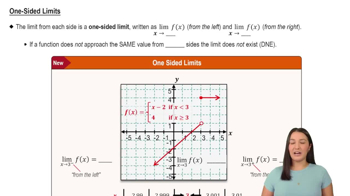
One-Sided Limits

Taylor Series

A Taylor series represents a function as an infinite sum of terms calculated from its derivatives at a single point. It approximates functions near that point, allowing complex expressions to be simplified and limits to be evaluated more easily.
Recommended video:
08:42
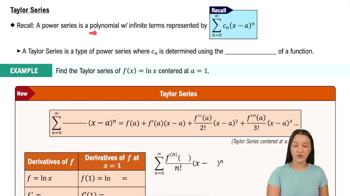
Taylor Series

Evaluating Limits Using Taylor Series

By expanding functions into their Taylor series near the limit point, indeterminate forms can be resolved by canceling terms or simplifying expressions. This method transforms complicated limits into algebraic ones, making it easier to find the limit value.
Recommended video:
08:42
Taylor Series
Related Practice
Textbook Question

Functions to power series Find power series representations centered at 0 for the following functions using known power series. Give the interval of convergence for the resulting series.

f(x) = 2x/(1 + x²)²

1
views

Textbook Question

Limits with a parameter Use Taylor series to evaluate the following limits. Express the result in terms of the nonzero real parameter(s).

lim ₓ→₀ (eᵃˣ − 1)/x

Textbook Question

Suppose a power series converges if |x−3|<4 and diverges if |x−3| ≥ 4. Determine the radius and interval of convergence.

Textbook Question

Differentiating and integrating power series Find the power series representation for g centered at 0 by differentiating or integrating the power series for f (perhaps more than once). Give the interval of convergence for the resulting series.


g(x) = − 1/(1 + x)² using f(x) = 1/(1 + x)

Textbook Question

Derivative trick Here is an alternative way to evaluate higher derivatives of a function f that may save time. Suppose you can find the Taylor series for f centered at the point a without evaluating derivatives (for example, from a known series). Then f⁽ᵏ⁾(a)=k! multiplied by the coefficient of (x−a)ᵏ. Use this idea to evaluate f⁽³⁾(0) and f⁽⁴⁾(0) for the following functions. Use known series and do not evaluate derivatives.


f(x) = eᶜᵒˢ ˣ

Textbook Question

Radius and interval of convergence Determine the radius and interval of convergence of the following power series.


∑ₖ₌₀∞ (x/3)ᵏ

1
views