Ch. 11 - Power Series
Briggs - Calculus: Early Transcendentals 3rd Edition
Briggs3rd EditionCalculus: Early TranscendentalsISBN: 9780136847243Not the one you use?Change textbook
Chapter 11, Problem 11.4.71

Derivative trick Here is an alternative way to evaluate higher derivatives of a function f that may save time. Suppose you can find the Taylor series for f centered at the point a without evaluating derivatives (for example, from a known series). Then f⁽ᵏ⁾(a)=k! multiplied by the coefficient of (x−a)ᵏ. Use this idea to evaluate f⁽³⁾(0) and f⁽⁴⁾(0) for the following functions. Use known series and do not evaluate derivatives.


f(x) = eᶜᵒˢ ˣ

Verified step by step guidance
1
Recall the key idea: if the Taylor series of a function \(f(x)\) centered at \(a\) is given by \(f(x) = \sum_{n=0}^\infty c_n (x - a)^n\), then the \(k\)-th derivative at \(a\) is \(f^{(k)}(a) = k! \cdot c_k\).
Since we want to find \(f^{(3)}(0)\) and \(f^{(4)}(0)\), we need the Taylor series of \(f(x) = e^{\cos x}\) centered at \(0\) and identify the coefficients of \(x^3\) and \(x^4\).
Start by recalling the Taylor series expansion of \(\cos x\) around \(0\): \(\cos x = 1 - \frac{x^2}{2!} + \frac{x^4}{4!} - \cdots\).
Substitute this series into the exponent of \(e^{\cos x}\) to get \(e^{1 - \frac{x^2}{2} + \frac{x^4}{24} - \cdots}\). Then rewrite this as \(e^1 \cdot e^{-\frac{x^2}{2} + \frac{x^4}{24} - \cdots}\).
Next, expand \(e^{-\frac{x^2}{2} + \frac{x^4}{24} - \cdots}\) as a power series in \(x\), keeping terms up to \(x^4\) since higher powers won't affect the coefficients for \(x^3\) and \(x^4\). Identify the coefficients of \(x^3\) and \(x^4\) in the full expansion \(e^{\cos x}\), then multiply each coefficient by \$3!\( and \)4!\( respectively to find \)f^{(3)}(0)\( and \)f^{(4)}(0)$.

Verified video answer for a similar problem:

This video solution was recommended by our tutors as helpful for the problem above.
Video duration:
4m
Was this helpful?

Key Concepts

Here are the essential concepts you must grasp in order to answer the question correctly.

Taylor Series Expansion

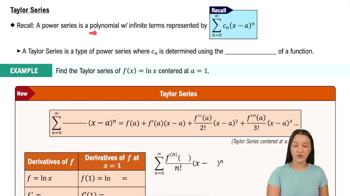
A Taylor series represents a function as an infinite sum of terms calculated from the derivatives at a single point. Centered at a point a, it expresses f(x) as a sum of powers of (x - a) multiplied by coefficients involving derivatives. This series allows approximation of functions and extraction of derivative information without direct differentiation.
Recommended video:
08:42
Taylor Series

Relationship Between Taylor Coefficients and Derivatives

The coefficient of the (x - a)^k term in a Taylor series is equal to f^(k)(a) divided by k!. This means the k-th derivative at a point can be found by multiplying the coefficient of (x - a)^k by k!. This relationship enables finding higher-order derivatives from series expansions without computing derivatives directly.
Recommended video:
08:42
Taylor Series

Using Known Series to Find Derivatives

When a function can be expressed as a composition or combination of functions with known Taylor series, one can substitute and manipulate these series to find the expansion of the composite function. This approach avoids direct differentiation and simplifies finding higher derivatives by identifying coefficients in the resulting series.
Recommended video:
06:45
Intro to Series: Partial Sums