
Ch. 11 - Power Series
Briggs - Calculus: Early Transcendentals 3rd Edition
Briggs3rd EditionCalculus: Early TranscendentalsISBN: 9780136847243Not the one you use?Change textbook
Chapter 11, Problem 11.1.46

Remainders Find the remainder Rₙ for the nth−order Taylor polynomial centered at a for the given functions. Express the result for a general value of n.


f(x) = 1/(1 - x), a=0

Verified step by step guidance
1
Identify the function and the center of the Taylor polynomial: here, the function is \(f(x) = \frac{1}{1 - x}\) and the Taylor polynomial is centered at \(a = 0\).
Recall the formula for the remainder (Lagrange form) of the nth-order Taylor polynomial centered at \(a\): \[R_n(x) = \frac{f^{(n+1)}(c)}{(n+1)!} (x - a)^{n+1}\] where \(c\) is some value between \(a\) and \(x\).
Find the \((n+1)\)th derivative of \(f(x)\). Since \(f(x) = (1 - x)^{-1}\), use the general formula for derivatives of this form: \[f^{(k)}(x) = k! \cdot (1 - x)^{-(k+1)}\] with appropriate sign considerations.
Substitute \(a = 0\) into the remainder formula and express \(R_n(x)\) in terms of \(f^{(n+1)}(c)\) and \((x - 0)^{n+1} = x^{n+1}\).
Write the final expression for the remainder \(R_n(x)\) as: \[R_n(x) = \frac{f^{(n+1)}(c)}{(n+1)!} x^{n+1}\] where \(c\) lies between \(0\) and \(x\), and \(f^{(n+1)}(c)\) is the \((n+1)\)th derivative evaluated at \(c\).

Verified video answer for a similar problem:

This video solution was recommended by our tutors as helpful for the problem above.
Video duration:
5m
Was this helpful?

Key Concepts

Here are the essential concepts you must grasp in order to answer the question correctly.

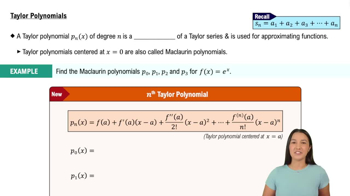
Taylor Polynomial

A Taylor polynomial of order n approximates a function near a point a using a finite sum of derivatives of the function at a. It is expressed as the sum of terms involving the function's derivatives up to the nth order, each multiplied by powers of (x - a) and divided by factorials.
Recommended video:
07:00
Taylor Polynomials

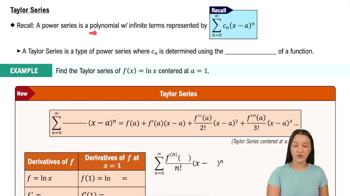
Remainder (Error) Term in Taylor Series

The remainder term Rₙ represents the difference between the actual function value and its nth-order Taylor polynomial approximation. It quantifies the error and can be expressed using forms like Lagrange's form, involving the (n+1)th derivative evaluated at some point between a and x.
Recommended video:
08:42
Taylor Series

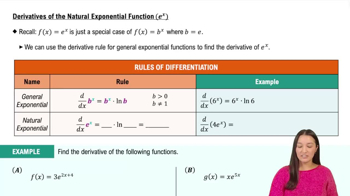
Derivatives of f(x) = 1/(1 - x)

For f(x) = 1/(1 - x), the nth derivative is n!/(1 - x)^(n+1). Understanding this pattern is essential to formulating the Taylor polynomial and remainder term, as the derivatives determine the coefficients and the behavior of the remainder.
Recommended video:
04:56
Derivative of the Natural Exponential Function (e^x)