
Ch. 11 - Power Series
Briggs - Calculus: Early Transcendentals 3rd Edition
Briggs3rd EditionCalculus: Early TranscendentalsISBN: 9780136847243Not the one you use?Change textbook
Chapter 11, Problem 11.3.7

In terms of the remainder, what does it mean for a Taylor series for a function f to converge to f?

Verified step by step guidance
1
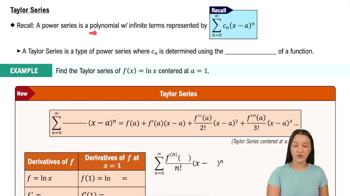
Recall that the Taylor series of a function \(f\) centered at a point \(a\) is given by the infinite sum \(\displaystyle \sum_{n=0}^{\infty} \frac{f^{(n)}(a)}{n!} (x - a)^n\).
The remainder term \(R_n(x)\) represents the error between the function \(f(x)\) and the \(n\)th partial sum of its Taylor series, i.e., \(R_n(x) = f(x) - \sum_{k=0}^n \frac{f^{(k)}(a)}{k!} (x - a)^k\).
For the Taylor series to converge to \(f(x)\) at a point \(x\), the remainder \(R_n(x)\) must approach zero as \(n\) approaches infinity: \(\lim_{n \to \infty} R_n(x) = 0\).
This means that the partial sums of the Taylor series get arbitrarily close to the actual function value \(f(x)\) as more terms are included.
Therefore, convergence of the Taylor series to \(f\) in terms of the remainder means the remainder term becomes negligible, ensuring the infinite series accurately represents the function at that point.

Verified video answer for a similar problem:

This video solution was recommended by our tutors as helpful for the problem above.
Video duration:
5m
Was this helpful?

Key Concepts

Here are the essential concepts you must grasp in order to answer the question correctly.

Taylor Series and Its Remainder

A Taylor series represents a function as an infinite sum of terms calculated from the function's derivatives at a single point. The remainder is the difference between the actual function value and the partial sum of the series up to a certain degree, measuring the error in approximation.
Recommended video:
08:42
Taylor Series

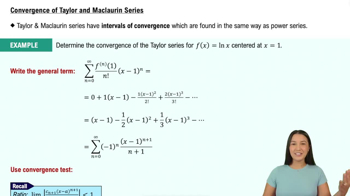
Convergence of a Taylor Series

Convergence means that as more terms are added, the Taylor series sum approaches the actual function value. For the series to converge to the function, the remainder must approach zero as the number of terms increases indefinitely.
Recommended video:
08:26
Convergence of Taylor & Maclaurin Series

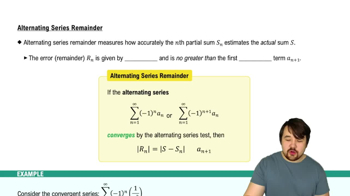
Role of the Remainder in Function Approximation

The remainder quantifies how closely the Taylor polynomial approximates the function. If the remainder tends to zero for all points in the interval, the Taylor series converges to the function, ensuring the series accurately represents the function within that domain.
Recommended video:
06:32
Alternating Series Remainder