Ch. 11 - Power Series
Briggs - Calculus: Early Transcendentals 3rd Edition
Briggs3rd EditionCalculus: Early TranscendentalsISBN: 9780136847243Not the one you use?Change textbook
Chapter 11, Problem 11.3.37

Manipulating Taylor series Use the Taylor series in Table 11.5 to find the first four nonzero terms of the Taylor series for the following functions centered at 0.


1/(1 − 2x)

Verified step by step guidance
1
Recall the Taylor series expansion for the function \( \frac{1}{1 - x} \) centered at 0, which is given by the geometric series: \( \sum_{n=0}^{\infty} x^n = 1 + x + x^2 + x^3 + \cdots \).
To find the Taylor series for \( \frac{1}{1 - 2x} \), substitute \( 2x \) in place of \( x \) in the geometric series expansion. This gives: \( \frac{1}{1 - 2x} = \sum_{n=0}^{\infty} (2x)^n = 1 + 2x + (2x)^2 + (2x)^3 + \cdots \).
Expand the powers of \( 2x \) in each term to write the series explicitly: \( 1 + 2x + 4x^2 + 8x^3 + \cdots \).
Identify the first four nonzero terms of the series, which correspond to the terms with powers \( x^0, x^1, x^2, \) and \( x^3 \).
Write the first four nonzero terms as \( 1 + 2x + 4x^2 + 8x^3 \), which is the Taylor series approximation of \( \frac{1}{1 - 2x} \) centered at 0 up to the third degree.

Verified video answer for a similar problem:

This video solution was recommended by our tutors as helpful for the problem above.
Video duration:
1m
Was this helpful?

Key Concepts

Here are the essential concepts you must grasp in order to answer the question correctly.

Taylor Series Expansion

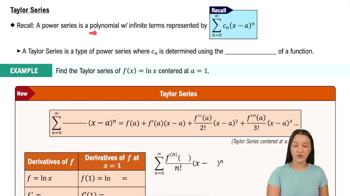
A Taylor series represents a function as an infinite sum of terms calculated from the derivatives of the function at a single point, usually centered at zero (Maclaurin series). It approximates functions using polynomials, making complex functions easier to analyze and compute.
Recommended video:
08:42
Taylor Series

Geometric Series and Its Taylor Series

The geometric series 1/(1 - x) can be expanded as 1 + x + x^2 + x^3 + ... for |x| < 1. Recognizing this form helps in manipulating similar functions like 1/(1 - 2x) by substituting variables, enabling straightforward derivation of their Taylor series.
Recommended video:
08:42
Taylor Series

Term-by-Term Substitution and Manipulation

To find the Taylor series of functions like 1/(1 - 2x), substitute the variable inside the known series (e.g., replace x with 2x in the geometric series). Then, expand and simplify term-by-term to identify the first four nonzero terms of the series centered at zero.
Recommended video:
05:44
Divergence Test (nth Term Test)