Ch. 11 - Power Series
Briggs - Calculus: Early Transcendentals 3rd Edition
Briggs3rd EditionCalculus: Early TranscendentalsISBN: 9780136847243Not the one you use?Change textbook
Chapter 11, Problem 11.1.43

Remainders Find the remainder Rₙ for the nth−order Taylor polynomial centered at a for the given functions. Express the result for a general value of n.


f(x) = e⁻ˣ, a = 0

Verified step by step guidance
1
Identify the function and the center of the Taylor polynomial: here, the function is \(f(x) = e^{-x}\) and the Taylor polynomial is centered at \(a = 0\).
Recall the general form of the remainder (Lagrange form) for the nth-order Taylor polynomial centered at \(a\): \[R_n(x) = \frac{f^{(n+1)}(c)}{(n+1)!} (x - a)^{n+1}\] where \(c\) is some value between \(a\) and \(x\).
Find the \((n+1)\)th derivative of \(f(x) = e^{-x}\). Note that derivatives of \(e^{-x}\) alternate signs but remain proportional to \(e^{-x}\). Express \(f^{(n+1)}(x)\) in terms of \(e^{-x}\) and a sign factor.
Substitute \(a = 0\) and the expression for \(f^{(n+1)}(c)\) into the remainder formula to get: \[R_n(x) = \frac{(-1)^{n+1} e^{-c}}{(n+1)!} x^{n+1}\] where \(c\) is between \(0\) and \(x\).
Interpret this remainder term as the error bound for approximating \(f(x)\) by its nth-order Taylor polynomial at \(a=0\), with the exact value depending on the unknown \(c\) in the interval between \(0\) and \(x\).

Verified video answer for a similar problem:

This video solution was recommended by our tutors as helpful for the problem above.
Video duration:
4m
Was this helpful?

Key Concepts

Here are the essential concepts you must grasp in order to answer the question correctly.

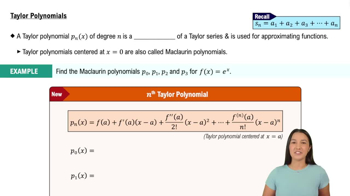
Taylor Polynomial

A Taylor polynomial approximates a function near a point a by using the function's derivatives at that point. The nth-order Taylor polynomial includes terms up to the nth derivative, providing a polynomial approximation that becomes more accurate as n increases.
Recommended video:
07:00
Taylor Polynomials

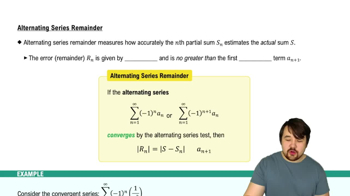
Remainder Term (Lagrange Form)

The remainder term Rₙ measures the error between the actual function and its nth-order Taylor polynomial. In Lagrange form, it is expressed using the (n+1)th derivative evaluated at some point between a and x, multiplied by (x - a)^(n+1) divided by (n+1)!.
Recommended video:
06:32
Alternating Series Remainder

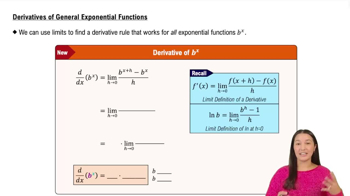
Derivatives of the Exponential Function

For f(x) = e^{-x}, all derivatives follow a predictable pattern: the kth derivative is (-1)^k e^{-x}. This property simplifies finding the remainder term since the (n+1)th derivative can be directly expressed, aiding in the general formula for Rₙ.
Recommended video:
04:50
Derivatives of General Exponential Functions