Ch. 11 - Power Series
Briggs - Calculus: Early Transcendentals 3rd Edition
Briggs3rd EditionCalculus: Early TranscendentalsISBN: 9780136847243Not the one you use?Change textbook
Chapter 11, Problem 11.4.47

Approximating real numbers Use an appropriate Taylor series to find the first four nonzero terms of an infinite series that is equal to the following numbers.
cos 2

Verified step by step guidance
1
Recall the Taylor series expansion of the cosine function centered at 0 (Maclaurin series): \[\cos x = \sum_{n=0}^{\infty} (-1)^n \frac{x^{2n}}{(2n)!} = 1 - \frac{x^2}{2!} + \frac{x^4}{4!} - \frac{x^6}{6!} + \cdots\]
To approximate \( \cos 2 \), substitute \( x = 2 \) into the series expansion: \[\cos 2 = 1 - \frac{2^2}{2!} + \frac{2^4}{4!} - \frac{2^6}{6!} + \cdots\]
Identify the first four nonzero terms of this series explicitly: 1st term: \( 1 \) 2nd term: \( - \frac{2^2}{2!} \) 3rd term: \( + \frac{2^4}{4!} \) 4th term: \( - \frac{2^6}{6!} \)
Write the partial sum of these four terms as the approximation for \( \cos 2 \): \[\cos 2 \approx 1 - \frac{2^2}{2!} + \frac{2^4}{4!} - \frac{2^6}{6!}\]
This expression represents the first four nonzero terms of the infinite Taylor series for \( \cos 2 \). You can stop here or calculate each factorial and power if a numerical approximation is desired.

Verified video answer for a similar problem:

This video solution was recommended by our tutors as helpful for the problem above.
Video duration:
2m
Was this helpful?

Key Concepts

Here are the essential concepts you must grasp in order to answer the question correctly.

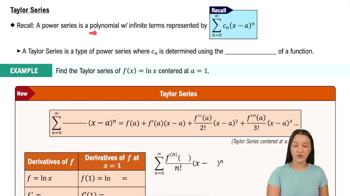
Taylor Series Expansion

A Taylor series represents a function as an infinite sum of terms calculated from the function's derivatives at a single point, usually around zero (Maclaurin series). It allows approximation of functions like cosine by polynomials, making complex functions easier to analyze and compute.
Recommended video:
08:42
Taylor Series

Maclaurin Series for Cosine

The Maclaurin series for cosine is a specific Taylor series centered at zero, given by cos(x) = 1 - x²/2! + x⁴/4! - x⁶/6! + ... . This alternating series includes only even powers of x and is used to approximate cosine values near zero.
Recommended video:
08:26
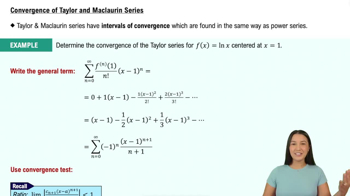
Convergence of Taylor & Maclaurin Series

Term Selection and Approximation Accuracy

When approximating functions using Taylor series, selecting the first few nonzero terms balances simplicity and accuracy. Including more terms improves precision but increases complexity. For cos(2), using the first four nonzero terms provides a good polynomial approximation of the value.
Recommended video:
05:44
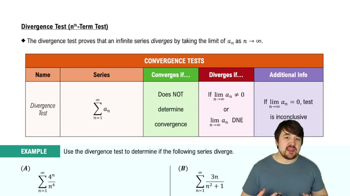
Divergence Test (nth Term Test)