Ch. 11 - Power Series
Briggs - Calculus: Early Transcendentals 3rd Edition
Briggs3rd EditionCalculus: Early TranscendentalsISBN: 9780136847243Not the one you use?Change textbook
Chapter 11, Problem 11.2.37

Radius of convergence Find the radius of convergence for the following power series.
∑ₖ₌₁∞ (k!xᵏ)/(kᵏ)

Verified step by step guidance
1
Identify the general term of the power series: \(a_k = \frac{k! x^k}{k^k}\).
Recall that the radius of convergence \(R\) can be found using the root test or ratio test. Here, the root test is often simpler for factorial expressions. The root test uses the formula: \(\frac{1}{R} = \limsup_{k \to \infty} \sqrt[k]{|a_k|}\).
Apply the root test by computing \(\sqrt[k]{|a_k|} = \sqrt[k]{\frac{k! |x|^k}{k^k}} = \frac{\sqrt[k]{k!} \cdot |x|}{k}\).
Use Stirling's approximation for large \(k\) to estimate \(k!\), which is \(k! \approx \sqrt{2 \pi k} \left(\frac{k}{e}\right)^k\). Taking the \(k\)th root gives \(\sqrt[k]{k!} \approx \frac{k}{e}\).
Substitute this approximation back into the expression to get \(\sqrt[k]{|a_k|} \approx \frac{\frac{k}{e} \cdot |x|}{k} = \frac{|x|}{e}\). Then, set \(\limsup_{k \to \infty} \sqrt[k]{|a_k|} = \frac{|x|}{e}\) and solve \(\frac{1}{R} = \frac{|x|}{e}\) to find the radius of convergence \(R\).

Verified video answer for a similar problem:

This video solution was recommended by our tutors as helpful for the problem above.
Video duration:
6m
Was this helpful?

Key Concepts

Here are the essential concepts you must grasp in order to answer the question correctly.

Radius of Convergence

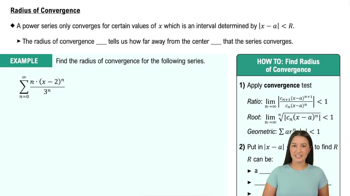
The radius of convergence of a power series is the distance from the center of the series within which the series converges absolutely. It determines the interval on the x-axis where the series represents a valid function. Finding this radius helps understand the domain of convergence for the series.
Recommended video:
07:36
Radius of Convergence

Ratio Test for Convergence

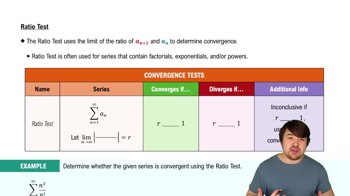
The ratio test is a method to determine the convergence of an infinite series by examining the limit of the absolute value of the ratio of consecutive terms. For power series, it is commonly used to find the radius of convergence by analyzing the limit of |a_{k+1}/a_k| as k approaches infinity.
Recommended video:
05:35
Ratio Test

Factorials and Exponential Growth

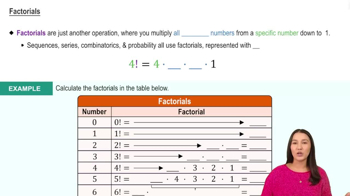
Factorials (k!) grow faster than exponential functions, which affects the behavior of series terms. Understanding how factorials compare to powers like k^k is crucial when applying convergence tests, as it influences the limit calculations and thus the radius of convergence.
Recommended video:
5:22
Factorials