
Ch. 11 - Power Series
Briggs - Calculus: Early Transcendentals 3rd Edition
Briggs3rd EditionCalculus: Early TranscendentalsISBN: 9780136847243Not the one you use?Change textbook
Chapter 11, Problem 11.1.65a

Explain why or why not Determine whether the following statements are true and give an explanation or counterexample.


a. Only even powers of x appear in the Taylor polynomials for f(x)=e⁻²ˣ centered at 0.

Verified step by step guidance
1
Recall that the Taylor polynomial of a function \(f(x)\) centered at 0 (Maclaurin series) is given by the sum \(\displaystyle \sum_{n=0}^\infty \frac{f^{(n)}(0)}{n!} x^n\), where \(f^{(n)}(0)\) is the \(n\)-th derivative of \(f\) evaluated at 0.
Consider the function \(f(x) = e^{-2x}\). Its Maclaurin series expansion can be found by substituting \(-2x\) into the exponential series \(e^t = \sum_{n=0}^\infty \frac{t^n}{n!}\), giving \(e^{-2x} = \sum_{n=0}^\infty \frac{(-2x)^n}{n!} = \sum_{n=0}^\infty \frac{(-2)^n}{n!} x^n\).
Notice that the series contains terms for all powers of \(x\), both even and odd, because \(n\) runs over all nonnegative integers and the coefficient \(\frac{(-2)^n}{n!}\) is nonzero for every \(n\).
Since the Taylor polynomial includes terms with odd powers of \(x\) (like \(x^1\), \(x^3\), etc.) with nonzero coefficients, it is not true that only even powers of \(x\) appear in the Taylor polynomials for \(f(x) = e^{-2x}\) centered at 0.
Therefore, the statement is false, and a counterexample is the first-degree term in the expansion, which is \(\frac{(-2)^1}{1!} x = -2x\), an odd power term.

Verified video answer for a similar problem:

This video solution was recommended by our tutors as helpful for the problem above.
Video duration:
3m
Was this helpful?

Key Concepts

Here are the essential concepts you must grasp in order to answer the question correctly.

Taylor Series Expansion

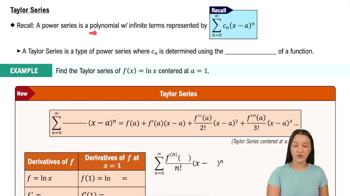
A Taylor series represents a function as an infinite sum of terms calculated from the function's derivatives at a single point. For a function f(x) centered at 0, the series is f(x) = Σ (f⁽ⁿ⁾(0)/n!) xⁿ, where n is a non-negative integer. Understanding how to find these derivatives and form the series is essential to analyze the polynomial terms.
Recommended video:
08:42
Taylor Series

Even and Odd Powers in Series

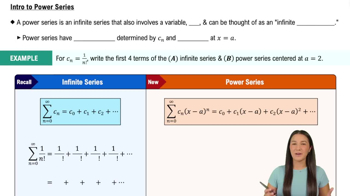
The presence of only even or odd powers in a Taylor series depends on the function's symmetry. Even functions satisfy f(-x) = f(x) and have Taylor expansions with only even powers, while odd functions satisfy f(-x) = -f(x) and have only odd powers. Recognizing the function's parity helps predict the powers appearing in its series.
Recommended video:
05:58
Intro to Power Series

Exponential Function and Its Derivatives

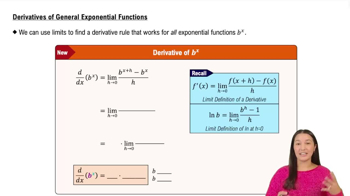
The exponential function e^u, where u is a function of x, has derivatives that follow a predictable pattern. For f(x) = e^{-2x}, each derivative involves powers of -2 and e^{-2x}. Evaluating these at 0 helps determine the coefficients in the Taylor series and whether odd or even powers appear.
Recommended video:
04:50
Derivatives of General Exponential Functions