
Textbook Question
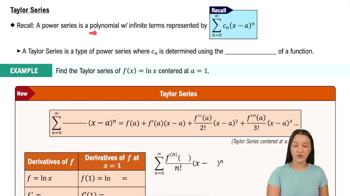
{Use of Tech} Binomial series
a. Find the first four nonzero terms of the binomial series centered at 0 for the given function.
f(x) = (1+x)⁻²/³; approximate 1.18⁻²/³.

 Verified step by step guidance
 08:42
08:42
 04:56
04:56 06:00
06:00{Use of Tech} Binomial series
a. Find the first four nonzero terms of the binomial series centered at 0 for the given function.
f(x) = (1+x)⁻²/³; approximate 1.18⁻²/³.
Matching functions with polynomials Match functions a–f with Taylor polynomials A–F (all centered at 0). Give reasons for your choices.
a. √(1 + 2x)
A. p₂(x)= 1 + 2x + 2x²
B. p₂(x) = 1 − 6x + 24x²
C. p₂(x) = 1 + x − x²/2
D. p₂(x) = 1 − 2x + 4x²
E. p₂(x) = 1 − x + (3/2)x²
F. p₂(x) = 1 − 2x + 2x²
Explain why or why not Determine whether the following statements are true and give an explanation or counterexample.
a. The function f(x) = √x has a Taylor series centered at 0.
{Use of Tech} Small argument approximations Consider the following common approximations when x is near zero.
a. Estimate f(0.1) and give a bound on the error in the approximation.
f(x) = eˣ ≈ 1 + x
Taylor series and interval of convergence
a. Use the definition of a Taylor/Maclaurin series to find the first four nonzero terms of the Taylor series for the given function centered at a.
f(x) = cosh 3x, a = 0
Explain why or why not Determine whether the following statements are true and give an explanation or counterexample.
a. Only even powers of x appear in the Taylor polynomials for f(x)=e⁻²ˣ centered at 0.