
Ch. 11 - Power Series
Briggs - Calculus: Early Transcendentals 3rd Edition
Briggs3rd EditionCalculus: Early TranscendentalsISBN: 9780136847243Not the one you use?Change textbook
Chapter 11, Problem 11.3.13a

Taylor series and interval of convergence


a. Use the definition of a Taylor/Maclaurin series to find the first four nonzero terms of the Taylor series for the given function centered at a.


f(x)=2/(1−x)³, a=0

Verified step by step guidance
1
Recall the definition of the Taylor series of a function \(f(x)\) centered at \(a=0\) (Maclaurin series): \[f(x) = \sum_{n=0}^{\infty} \frac{f^{(n)}(0)}{n!} x^n,\] where \(f^{(n)}(0)\) is the \(n\)-th derivative of \(f\) evaluated at 0.
Start by finding the function and its first few derivatives: - \(f(x) = \frac{2}{(1-x)^3}\) Calculate \(f'(x)\), \(f''(x)\), and \(f'''(x)\) using the chain rule and power rule.
Evaluate each derivative at \(x=0\): - Compute \(f(0)\), \(f'(0)\), \(f''(0)\), and \(f'''(0)\) to find the coefficients for the Taylor series terms.
Write the first four nonzero terms of the Taylor series using the formula: \[\frac{f^{(n)}(0)}{n!} x^n\] for \(n=0,1,2,3\).
Express the partial sum of the Taylor series with these four terms explicitly, which approximates \(f(x)\) near \(x=0\).

Verified video answer for a similar problem:

This video solution was recommended by our tutors as helpful for the problem above.
Video duration:
3m
Was this helpful?

Key Concepts

Here are the essential concepts you must grasp in order to answer the question correctly.

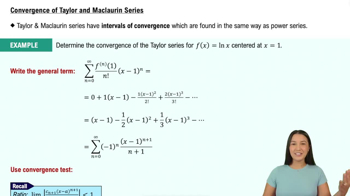
Taylor and Maclaurin Series

A Taylor series represents a function as an infinite sum of terms calculated from the derivatives at a single point. When centered at zero, it is called a Maclaurin series. Each term involves the nth derivative of the function evaluated at the center, multiplied by (x - a)^n and divided by n!.
Recommended video:
08:26
Convergence of Taylor & Maclaurin Series

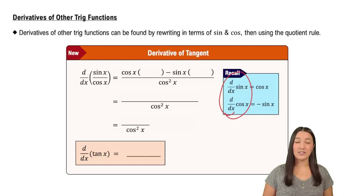
Derivatives of the Function

To find the Taylor series terms, you must compute successive derivatives of the function at the center point. These derivatives determine the coefficients of the series. For f(x) = 2/(1−x)^3, calculating the first few derivatives at x=0 is essential to find the first four nonzero terms.
Recommended video:
06:30
Derivatives of Other Trig Functions

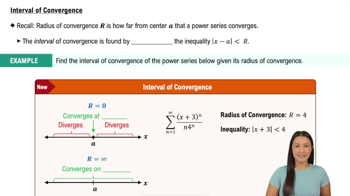
Interval of Convergence

The interval of convergence is the range of x-values for which the Taylor series converges to the function. It depends on the function's singularities and can be found using tests like the ratio test. For rational functions like 2/(1−x)^3, the interval is typically related to the distance from the center to the nearest singularity.
Recommended video:
08:44
Interval of Convergence
Related Practice
Textbook Question

Probability: sudden−death playoff Teams A and B go into suddendeath overtime after playing to a tie. The teams alternate possession of the ball, and the first team to score wins. Assume each team has a 1/6 chance of scoring when it has the ball, and Team A has the ball first.


a. The probability that Team A ultimately wins is ∑ₖ₌₀∞ (1/6)(5/6)²ᵏ. Evaluate this series.

Textbook Question

Matching functions with polynomials Match functions a–f with Taylor polynomials A–F (all centered at 0). Give reasons for your choices.


a. √(1 + 2x)


A. p₂(x)= 1 + 2x + 2x²

B. p₂(x) = 1 − 6x + 24x²

C. p₂(x) = 1 + x − x²/2

D. p₂(x) = 1 − 2x + 4x²

E. p₂(x) = 1 − x + (3/2)x²

F. p₂(x) = 1 − 2x + 2x²

1
views
Textbook Question

Taylor series


a. Use the definition of a Taylor series to find the first four nonzero terms of the Taylor series for the given function centered at a.


f(x) = ln x, a = 3

1
views
Textbook Question

Explain why or why not Determine whether the following statements are true and give an explanation or counterexample.

a. The function f(x) = √x has a Taylor series centered at 0.

Textbook Question

Taylor series


a. Use the definition of a Taylor series to find the first four nonzero terms of the Taylor series for the given function centered at a.


f(x) = 2ˣ, a = 1

Textbook Question

Explain why or why not Determine whether the following statements are true and give an explanation or counterexample.


a. Only even powers of x appear in the Taylor polynomials for f(x)=e⁻²ˣ centered at 0.

1
views