
Ch. 10 - Sequences and Infinite Series
Briggs - Calculus: Early Transcendentals 3rd Edition
Briggs3rd EditionCalculus: Early TranscendentalsISBN: 9780136847243Not the one you use?Change textbook
Chapter 10, Problem 10.1.7

The first ten terms of the sequence {(1 + 1/10ⁿ)^10ⁿ}∞ ₙ₌₁ are rounded to 8 digits right of the decimal point (see table). Make a conjecture about the limit of the sequence.
n an
1 2.59374246
2 2.70481383
3 2.71692393
4 2.71814593
5 2.71826824
6 2.71828047
7 2.71828169
8 2.71828179
9 2.71828204
10 2.71828203

Verified step by step guidance
1
Recognize that the given sequence is defined as \(a_n = \left(1 + \frac{1}{10^n}\right)^{10^n}\), where \(n\) is a positive integer.
Recall the well-known limit definition of the mathematical constant \(e\), which is \(\lim_{m \to \infty} \left(1 + \frac{1}{m}\right)^m = e\).
Notice that in the sequence, the exponent and the denominator inside the parentheses are both powers of 10, specifically \$10^n\(, which grows very large as \)n$ increases.
Based on the pattern of the terms given and the known limit definition, conjecture that as \(n\) approaches infinity, \(a_n\) approaches the constant \(e\).
To confirm this conjecture, you could compare the numerical values of \(a_n\) for large \(n\) with the known decimal expansion of \(e \approx 2.718281828\ldots\) and observe the convergence.

Verified video answer for a similar problem:

This video solution was recommended by our tutors as helpful for the problem above.
Video duration:
2m
Was this helpful?

Key Concepts

Here are the essential concepts you must grasp in order to answer the question correctly.

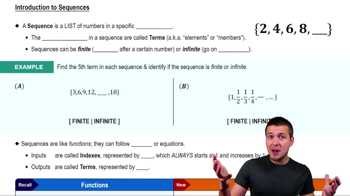
Sequences and Limits

A sequence is an ordered list of numbers defined by a specific rule. The limit of a sequence is the value that the terms approach as the index goes to infinity. Understanding limits helps determine the long-term behavior of sequences, which is essential for making conjectures about convergence.
Recommended video:
Guided course
8:22
Introduction to Sequences

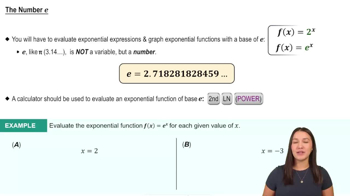
Exponential Functions and the Number e

The expression (1 + 1/n)^n is a classic sequence that approaches the mathematical constant e (~2.71828) as n becomes large. This sequence illustrates how exponential growth can be approximated by limits, and recognizing this helps identify the limit in the given problem.
Recommended video:
4:47
The Number e

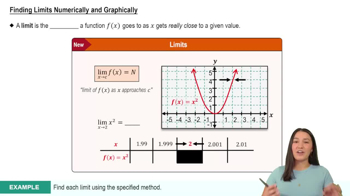
Rounding and Numerical Approximation

Rounding numbers to a fixed number of decimal places affects the precision of numerical values. When analyzing sequences numerically, understanding rounding helps interpret the data correctly and assess how close the terms are to the conjectured limit.
Recommended video:
6:47
Finding Limits Numerically and Graphically