
Ch. 10 - Sequences and Infinite Series
Briggs - Calculus: Early Transcendentals 3rd Edition
Briggs3rd EditionCalculus: Early TranscendentalsISBN: 9780136847243Not the one you use?Change textbook
Chapter 10, Problem 10.2.27

13–52. Limits of sequences
Find the limit of the following sequences or determine that the sequence diverges.


{2ⁿ⁺¹3⁻ⁿ}

Verified step by step guidance
1
Identify the general term of the sequence, which is given by \(a_n = 2^{n+1} 3^{-n}\).
Rewrite the term to express it in a simpler form by separating the powers: \(a_n = 2^{n+1} \times \frac{1}{3^n} = 2 \times 2^n \times 3^{-n}\).
Combine the exponential terms with the same exponent: \(a_n = 2 \times \left( \frac{2}{3} \right)^n\).
Analyze the base of the exponential term \(\left( \frac{2}{3} \right)\) to determine the behavior as \(n\) approaches infinity. Since \(\frac{2}{3} < 1\), the term \(\left( \frac{2}{3} \right)^n\) approaches 0 as \(n \to \infty\).
Conclude that the limit of the sequence \(a_n\) as \(n\) approaches infinity is \(2 \times 0 = 0\).

Verified video answer for a similar problem:

This video solution was recommended by our tutors as helpful for the problem above.
Video duration:
3m
Was this helpful?

Key Concepts

Here are the essential concepts you must grasp in order to answer the question correctly.

Limits of Sequences

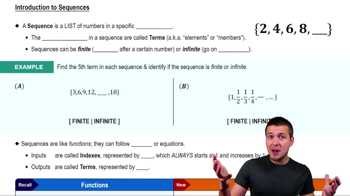
The limit of a sequence describes the value that the terms of the sequence approach as the index goes to infinity. If the terms get arbitrarily close to a finite number, the sequence converges; otherwise, it diverges.
Recommended video:
Guided course
8:22
Introduction to Sequences

Exponential Functions and Their Behavior

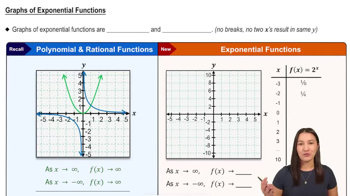
Sequences involving exponential terms like 2^(n+1) and 3^(-n) grow or decay depending on the base. Understanding how exponential growth and decay affect the sequence's terms is crucial to determining the limit.
Recommended video:
5:46
Graphs of Exponential Functions

Simplifying and Manipulating Sequences

To find limits, it is often necessary to rewrite the sequence in a simpler form, such as combining exponents or factoring terms. This helps reveal dominant terms and makes it easier to analyze the behavior as n approaches infinity.
Recommended video:
Guided course
8:22
Introduction to Sequences