
Ch. 10 - Sequences and Infinite Series
Briggs - Calculus: Early Transcendentals 3rd Edition
Briggs3rd EditionCalculus: Early TranscendentalsISBN: 9780136847243Not the one you use?Change textbook
Chapter 10, Problem 10.7.43

32–49. Choose your test Use the test of your choice to determine whether the following series converge absolutely, converge conditionally, or diverge.
∑ (from k = 1 to ∞) 2ᵏ k! / kᵏ

Verified step by step guidance
1
First, write down the general term of the series: \(a_k = \frac{2^k \cdot k!}{k^k}\).
To determine absolute convergence, consider the absolute value of the terms, which is the same here since all terms are positive: \(|a_k| = \frac{2^k \cdot k!}{k^k}\).
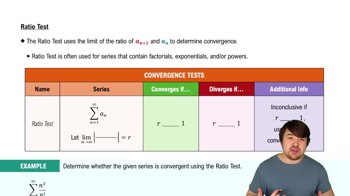
Apply the Root Test or Ratio Test to analyze the behavior of \(a_k\) as \(k\) approaches infinity. The Ratio Test is often convenient for factorials, so compute the limit \(L = \lim_{k \to \infty} \left| \frac{a_{k+1}}{a_k} \right|\).
Express \(\frac{a_{k+1}}{a_k}\) explicitly: \(\frac{2^{k+1} (k+1)! / (k+1)^{k+1}}{2^k k! / k^k} = 2 \cdot (k+1) \cdot \frac{k^k}{(k+1)^{k+1}}\).
Simplify the expression and evaluate the limit \(L\). If \(L < 1\), the series converges absolutely; if \(L > 1\), it diverges; if \(L = 1\), the test is inconclusive and you may need to try another test.

Verified video answer for a similar problem:

This video solution was recommended by our tutors as helpful for the problem above.
Video duration:
8m
Was this helpful?

Key Concepts

Here are the essential concepts you must grasp in order to answer the question correctly.

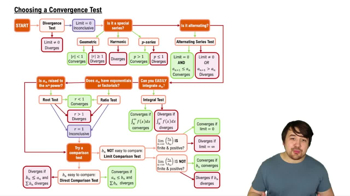
Absolute and Conditional Convergence

A series converges absolutely if the series of absolute values converges. If the original series converges but not absolutely, it converges conditionally. Understanding these distinctions helps classify the behavior of infinite series.
Recommended video:
07:51
Choosing a Convergence Test

Ratio Test

The Ratio Test determines convergence by examining the limit of the ratio of consecutive terms. If this limit is less than 1, the series converges absolutely; if greater than 1, it diverges. It is especially useful for series involving factorials and exponentials.
Recommended video:
05:35
Ratio Test

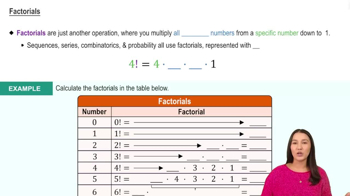
Factorials and Exponentials in Series

Factorials (k!) grow faster than exponentials (like 2^k), but when combined with terms like k^k, the growth rates affect convergence. Understanding how these terms compare helps in applying tests like the Ratio Test effectively.
Recommended video:
5:22
Factorials
Related Practice
Textbook Question

The first ten terms of the sequence {(1 + 1/10ⁿ)^10ⁿ}∞ ₙ₌₁ are rounded to 8 digits right of the decimal point (see table). Make a conjecture about the limit of the sequence.

n an

1 2.59374246

2 2.70481383

3 2.71692393

4 2.71814593

5 2.71826824

6 2.71828047

7 2.71828169

8 2.71828179

9 2.71828204

10 2.71828203

1
views
Textbook Question

40–62. Choose your test Use the test of your choice to determine whether the following series converge.

∑ (k = 1 to ∞) tan(1 / k)

Textbook Question

61–66. Sequences of partial sums For the following infinite series, find the first four terms of the sequence of partial sums. Then make a conjecture about the value of the infinite series or state that the series diverges.


4 + 0.9 + 0.09 + 0.009 + ⋯  

1
views
Textbook Question

45–48. {Use of Tech} Explicit formulas for sequences Consider the formulas for the following sequences {aₙ}ₙ₌₁∞

 Make a table with at least ten terms and determine a plausible limit of the sequence or state that the sequence diverges.

aₙ = ⁿ² + n ;n = 1, 2, 3, …

2
views
Textbook Question

54–69. Telescoping series

For the following telescoping series, find a formula for the nth term of the sequence of partial sums {Sₙ}. Then evaluate limₙ→∞ Sₙ to obtain the value of the series or state that the series diverges.


65. ∑ (k = 1 to ∞) (1 / √(k + 1) – 1 / √(k + 3))

Textbook Question

11–86. Applying convergence tests Determine whether the following series converge. Justify your answers.

∑ (from j = 2 to ∞)1 / (j ln¹⁰j)