Ch. 10 - Sequences and Infinite Series
Briggs - Calculus: Early Transcendentals 3rd Edition
Briggs3rd EditionCalculus: Early TranscendentalsISBN: 9780136847243Not the one you use?Change textbook
Chapter 10, Problem 10.R.41

Finding steady states using infinite series Solve Exercise 40 by expressing the amount of aspirin in your blood as a geometric series and evaluating the series.

Verified step by step guidance
1
Identify the problem context: The amount of aspirin in the blood over time can be modeled as a geometric series because each dose contributes a fraction of the previous amount due to elimination from the body.
Define the terms of the geometric series: Let the initial dose be \( D \), and let the fraction of aspirin remaining after each time interval be \( r \) (where \( 0 < r < 1 \)). Then the amount after the first dose is \( D \), after the second dose is \( D \times r \), after the third dose is \( D \times r^2 \), and so on.
Write the infinite geometric series representing the total amount of aspirin in the blood as \( S = D + D r + D r^2 + D r^3 + \cdots \).
Recall the formula for the sum of an infinite geometric series when \( |r| < 1 \): \[ S = \frac{a}{1 - r} \] where \( a \) is the first term. In this case, \( a = D \).
Substitute the values into the formula to express the steady-state amount of aspirin in the blood as \( S = \frac{D}{1 - r} \). This represents the long-term amount after many doses.

Verified video answer for a similar problem:

This video solution was recommended by our tutors as helpful for the problem above.
Video duration:
3m
Was this helpful?

Key Concepts

Here are the essential concepts you must grasp in order to answer the question correctly.

Geometric Series

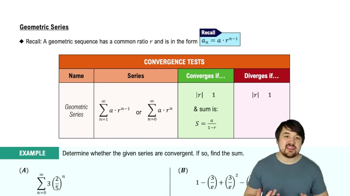
A geometric series is the sum of the terms of a geometric sequence, where each term is found by multiplying the previous term by a constant ratio. It can be expressed as S = a + ar + ar² + ... , and if |r| < 1, the infinite series converges to S = a / (1 - r). This concept is essential for modeling repeated processes like drug accumulation.
Recommended video:
06:00
Geometric Series

Steady State in Infinite Series

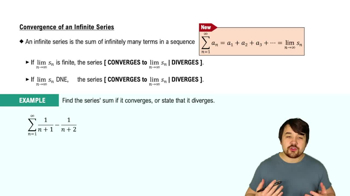
The steady state refers to a condition where the quantity being modeled stabilizes and no longer changes significantly over time. In the context of an infinite geometric series, the steady state corresponds to the sum of the infinite series, representing the long-term amount of aspirin in the blood after many doses.
Recommended video:
06:52
Convergence of an Infinite Series

Modeling Drug Concentration with Series

Drug concentration in the bloodstream over time can be modeled using infinite series by considering repeated doses and elimination rates. Each dose contributes an amount that decreases geometrically due to metabolism, allowing the total concentration to be expressed as a geometric series whose sum predicts the steady-state level.
Recommended video:
06:00
Geometric Series