Finding steady states using infinite series Solve Exercise 40 by expressing the amount of aspirin in your blood as a geometric series and evaluating the series.

Ch. 10 - Sequences and Infinite Series
Briggs3rd EditionCalculus: Early TranscendentalsISBN: 9780136847243Not the one you use?Change textbook
Chapter 10, Problem 10.R.1a
Explain why or why not
Determine whether the following statements are true and give an explanation or counterexample.
a.The terms of the sequence {aₙ} increase in magnitude, so the limit of the sequence does not exist.
Verified step by step guidance1
First, understand what it means for the terms of a sequence \( \{a_n\} \) to increase in magnitude. This means that the absolute values \( |a_n| \) are getting larger as \( n \) increases.
Recall that a sequence \( \{a_n\} \) converges to a limit \( L \) if and only if the terms get arbitrarily close to \( L \) as \( n \to \infty \). If the magnitude \( |a_n| \) increases without bound, the terms cannot approach a finite limit.
However, consider the possibility that the terms might oscillate or approach zero despite increasing magnitude. For example, if \( a_n = (-1)^n n \), the magnitude increases but the sequence does not converge because it oscillates and grows without bound.
On the other hand, if the magnitude increases but the terms approach zero, this would be a contradiction because the magnitude cannot increase and approach zero simultaneously.
Therefore, if the terms of the sequence increase in magnitude without bound, the sequence does not have a finite limit. This means the statement is true: increasing magnitude implies the limit does not exist.

Verified video answer for a similar problem:
This video solution was recommended by our tutors as helpful for the problem above.
Video duration:
1mWas this helpful?
Key Concepts
Here are the essential concepts you must grasp in order to answer the question correctly.
Sequence and Limit of a Sequence
A sequence is an ordered list of numbers, and its limit is the value the terms approach as the index goes to infinity. If the terms get closer to a specific number, the sequence converges; otherwise, it diverges. Understanding limits helps determine the behavior of sequences at infinity.
Recommended video:
Guided course
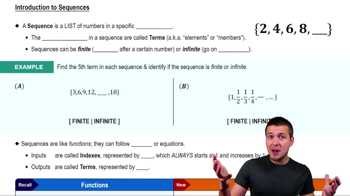
Introduction to Sequences
Magnitude (Absolute Value) of Sequence Terms
The magnitude or absolute value of a term measures its distance from zero, ignoring sign. A sequence can increase in magnitude even if terms alternate in sign. This concept is crucial to analyze whether the terms grow without bound or oscillate.
Recommended video:
Guided course
Introduction to Sequences
Convergence Criteria and Counterexamples
A sequence converges if its terms approach a finite limit. Increasing magnitude often suggests divergence, but exceptions exist. Providing counterexamples, such as sequences with increasing magnitude but convergent behavior, helps test the truth of statements rigorously.
Recommended video:
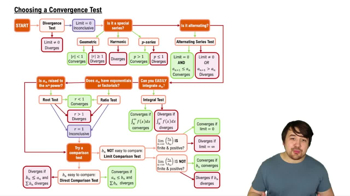
Choosing a Convergence Test
Related Practice
Textbook Question
Textbook Question
a.Does the sequence { k/(k + 1) } converge? Why or why not?
1
views
Textbook Question
12–24. Limits of sequences Evaluate the limit of the sequence or state that it does not exist.
aₙ = (–1)ⁿ (3n³ + 4n) / (6n³ + 5)
1
views
Textbook Question
42–76. Convergence or divergence Use a convergence test of your choice to determine whether the following series converge.
∑ (from k = 1 to ∞)2ᵏ / eᵏ
Textbook Question
42–76. Convergence or divergence Use a convergence test of your choice to determine whether the following series converge.
∑ (from k = 1 to ∞)(7 + sin k) / k²
Textbook Question
Estimate the value of the series ∑ (from k = 1 to ∞)1 / (2k + 5)³ to within 10⁻⁴ of its exact value.