Ch. 10 - Sequences and Infinite Series
Briggs - Calculus: Early Transcendentals 3rd Edition
Briggs3rd EditionCalculus: Early TranscendentalsISBN: 9780136847243Not the one you use?Change textbook
Chapter 10, Problem 10.R.93

{Use of Tech} Error in a finite alternating sum
How many terms of the series ∑ (from k = 1 to ∞)(−1)ᵏ⁺¹ / k⁴ must be summed to ensure that the approximation error is less than 10⁻⁸?

Verified step by step guidance
1
Recognize that the given series is an alternating series of the form \( \sum_{k=1}^\infty (-1)^{k+1} \frac{1}{k^4} \), which satisfies the conditions of the Alternating Series Test: the terms \( \frac{1}{k^4} \) are positive, decreasing, and approach zero as \( k \to \infty \).
Recall the Alternating Series Estimation Theorem, which states that the absolute error when approximating the sum by the first \( n \) terms is less than or equal to the absolute value of the first omitted term, i.e., \( |R_n| \leq \left| a_{n+1} \right| \).
Set up the inequality for the error bound: \( \left| a_{n+1} \right| = \frac{1}{(n+1)^4} < 10^{-8} \), since the error must be less than \( 10^{-8} \).
Solve the inequality \( \frac{1}{(n+1)^4} < 10^{-8} \) by taking reciprocals and then the fourth root: \( (n+1)^4 > 10^{8} \) which implies \( n+1 > (10^{8})^{1/4} \).
Calculate \( (10^{8})^{1/4} = 10^{8/4} = 10^{2} = 100 \), so \( n+1 > 100 \) and therefore \( n \geq 100 \). This means you must sum at least 100 terms to ensure the error is less than \( 10^{-8} \).

Verified video answer for a similar problem:

This video solution was recommended by our tutors as helpful for the problem above.
Video duration:
2m
Was this helpful?

Key Concepts

Here are the essential concepts you must grasp in order to answer the question correctly.

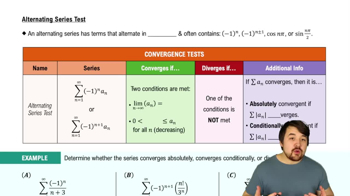
Alternating Series and Alternating Series Test

An alternating series is a series whose terms alternate in sign. The Alternating Series Test states that if the absolute value of the terms decreases monotonically to zero, the series converges. This test also provides a way to estimate the error when approximating the sum by partial sums.
Recommended video:
10:54
Alternating Series Test

Error Bound for Alternating Series

For an alternating series that meets the conditions of the Alternating Series Test, the error made by stopping at the nth term is less than or equal to the absolute value of the (n+1)th term. This allows us to control the approximation error by choosing a sufficient number of terms.
Recommended video:
06:00
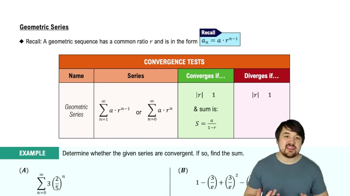
Geometric Series

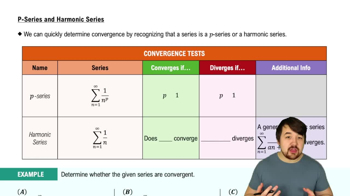
Convergence Rate of p-Series with p=4

The given series involves terms of the form 1/k⁴, which is a p-series with p=4. Since p > 1, the series converges rapidly. Understanding the rate of decay of terms helps in estimating how many terms are needed to achieve a desired accuracy.
Recommended video:
04:30
P-Series and Harmonic Series