
Ch. 10 - Sequences and Infinite Series
Briggs - Calculus: Early Transcendentals 3rd Edition
Briggs3rd EditionCalculus: Early TranscendentalsISBN: 9780136847243Not the one you use?Change textbook
Chapter 10, Problem 10.1.71c

Explain why or why not
Determine whether the following statements are true and give an explanation or counterexample.


c.If the terms of the sequence {aₙ} are positive and increasing, then the sequence of partial sums for the series∑⁽∞⁾ₖ₌₁aₖ diverges.

Verified step by step guidance
1
Recall that the sequence {aₙ} consists of positive and increasing terms, meaning \( aₙ > 0 \) and \( a_{n+1} \geq a_n \) for all \( n \).
The series in question is \( \sum_{k=1}^{\infty} a_k \), and its partial sums are defined as \( S_n = \sum_{k=1}^n a_k \).
Since each term \( a_k \) is positive, the partial sums \( S_n \) form an increasing sequence because adding a positive term increases the sum: \( S_{n+1} = S_n + a_{n+1} > S_n \).
Because the terms \( a_n \) are increasing and positive, the terms do not approach zero. In fact, \( \lim_{n \to \infty} a_n \neq 0 \), which is a necessary condition for series convergence.
Therefore, since the terms do not tend to zero, the series \( \sum_{k=1}^{\infty} a_k \) must diverge, meaning the sequence of partial sums \( S_n \) diverges to infinity.

Verified video answer for a similar problem:

This video solution was recommended by our tutors as helpful for the problem above.
Video duration:
3m
Was this helpful?

Key Concepts

Here are the essential concepts you must grasp in order to answer the question correctly.

Monotonic Sequences

A sequence is monotonic if it is either entirely non-increasing or non-decreasing. In this question, the sequence {aₙ} is positive and increasing, meaning each term is greater than or equal to the previous one. Understanding monotonicity helps analyze the behavior and limits of sequences.
Recommended video:
Guided course
8:22
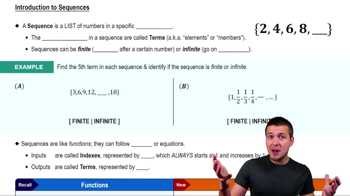
Introduction to Sequences

Partial Sums and Series Convergence

The partial sums of a series are the sums of its first n terms. The convergence or divergence of a series depends on whether these partial sums approach a finite limit as n approaches infinity. If the partial sums grow without bound, the series diverges.
Recommended video:
06:45
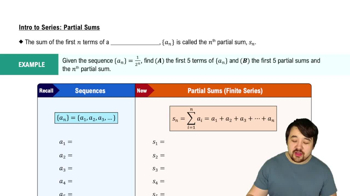
Intro to Series: Partial Sums

Comparison Test and Counterexamples in Series

To determine if a series converges or diverges, comparison tests can be used by comparing with known series. Counterexamples are important to disprove general statements; for instance, an increasing positive sequence might have partial sums that diverge or converge, depending on the terms' growth rate.
Recommended video:
09:25
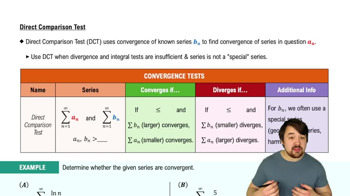
Direct Comparison Test
Related Practice
Textbook Question

{Use of Tech} A savings plan

James begins a savings plan in which he deposits \(100 at the beginning of each month into an account that earns 9% interest annually, or equivalently, 0.75% per month.

To be clear, on the first day of each month, the bank adds 0.75% of the current balance as interest, and then James deposits \)100.


Let Bₙ be the balance in the account after the nᵗʰ payment, where B₀ = \(0.


c.How many months are needed to reach a balance of \)5000?

1
views
Textbook Question

72–75. {Use of Tech} Practical sequences

Consider the following situations that generate a sequence


c.Find a recurrence relation that generates the sequence.


Drug elimination

Jack took a 200-mg dose of a pain killer at midnight. Every hour, 5% of the drug is washed out of his bloodstream. Let dₙ be the amount of drug in Jack’s blood n hours after the drug was taken, where d₀ = 200mg.

1
views
Textbook Question

Explain why or why not Determine whether the following statements are true and give an explanation or counterexample.


c. If lim (as k → ∞) ᵏ√|aₖ| = 1/4, then ∑ 10aₖ converges absolutely.

Textbook Question

27–34. Working with sequences Several terms of a sequence {aₙ}ₙ₌₁∞ are given.

c. Find an explicit formula for the nth term of the sequence.


{1, 3, 9, 27, 81, ......}

1
views
Textbook Question

27–34. Working with sequences Several terms of a sequence {aₙ}ₙ₌₁∞ are given.

c. Find an explicit formula for the nth term of the sequence.


{-5, 5, -5, 5, ......}

1
views
Textbook Question

41–44. {Use of Tech} Remainders and estimates Consider the following convergent series.


c. Find lower and upper bounds (Lₙ and Uₙ, respectively) on the exact value of the series.


43. ∑ (k = 1 to ∞) 1 / 3ᵏ

1
views