
Ch. 10 - Sequences and Infinite Series
Briggs - Calculus: Early Transcendentals 3rd Edition
Briggs3rd EditionCalculus: Early TranscendentalsISBN: 9780136847243Not the one you use?Change textbook
Chapter 10, Problem 10.1.31c

27–34. Working with sequences Several terms of a sequence {aₙ}ₙ₌₁∞ are given.
c. Find an explicit formula for the nth term of the sequence.


{1, 3, 9, 27, 81, ......}

Verified step by step guidance
1
Identify the pattern in the given sequence: {1, 3, 9, 27, 81, ...}. Notice how each term relates to the previous one by multiplication.
Recognize that the sequence is geometric because each term is obtained by multiplying the previous term by a constant ratio. Calculate the common ratio \( r \) by dividing the second term by the first term: \( r = \frac{3}{1} \).
Recall the general formula for the nth term of a geometric sequence: \( a_n = a_1 \times r^{n-1} \), where \( a_1 \) is the first term and \( r \) is the common ratio.
Substitute the known values into the formula: \( a_1 = 1 \) and \( r = 3 \), so the explicit formula becomes \( a_n = 1 \times 3^{n-1} \).
Simplify the formula if possible. In this case, the explicit formula for the nth term is \( a_n = 3^{n-1} \).

Verified video answer for a similar problem:

This video solution was recommended by our tutors as helpful for the problem above.
Video duration:
1m
Was this helpful?

Key Concepts

Here are the essential concepts you must grasp in order to answer the question correctly.

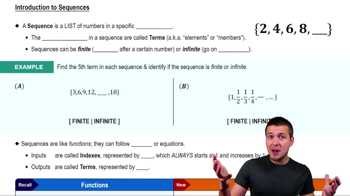
Sequences and Terms

A sequence is an ordered list of numbers where each number is called a term. The nth term, denoted as aₙ, represents the value at position n in the sequence. Understanding how terms progress helps in identifying patterns and formulating explicit expressions.
Recommended video:
Guided course
8:22
Introduction to Sequences

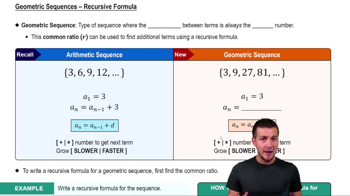
Geometric Sequences

A geometric sequence is one where each term is found by multiplying the previous term by a constant ratio. For example, in the sequence {1, 3, 9, 27, 81, ...}, each term is multiplied by 3. Recognizing this pattern is key to finding the explicit formula.
Recommended video:
Guided course
04:18
Geometric Sequences - Recursive Formula

Explicit Formula for nth Term

The explicit formula expresses the nth term directly in terms of n, without needing previous terms. For geometric sequences, it is generally aₙ = a₁ * r^(n-1), where a₁ is the first term and r is the common ratio. This formula allows quick calculation of any term.
Recommended video:
05:44
Divergence Test (nth Term Test)
Related Practice
Textbook Question

72–75. {Use of Tech} Practical sequences

Consider the following situations that generate a sequence


c.Find a recurrence relation that generates the sequence.


Drug elimination

Jack took a 200-mg dose of a pain killer at midnight. Every hour, 5% of the drug is washed out of his bloodstream. Let dₙ be the amount of drug in Jack’s blood n hours after the drug was taken, where d₀ = 200mg.

1
views
Textbook Question

Explain why or why not

Determine whether the following statements are true and give an explanation or counterexample.


c.The convergent sequences {aₙ} and {bₙ} differ in their first 100 terms, but aₙ = bₙ for n > 100.

It follows that limₙ→∞aₙ = limₙ→∞bₙ.

Textbook Question

{Use of Tech} Periodic dosing

Many people take aspirin on a regular basis as a preventive measure for heart disease. Suppose a person takes 80 mg of aspirin every 24 hours. Assume aspirin has a half-life of 24 hours; that is, every 24 hours, half of the drug in the blood is eliminated.


c.Assuming the sequence has a limit, confirm the result of part (b) by finding the limit of {dₙ} directly.

1
views
Textbook Question

Explain why or why not

Determine whether the following statements are true and give an explanation or counterexample.


c.If the terms of the sequence {aₙ} are positive and increasing, then the sequence of partial sums for the series∑⁽∞⁾ₖ₌₁aₖ diverges.

Textbook Question

27–34. Working with sequences Several terms of a sequence {aₙ}ₙ₌₁∞ are given.

c. Find an explicit formula for the nth term of the sequence.


{-5, 5, -5, 5, ......}

1
views
Textbook Question

41–44. {Use of Tech} Remainders and estimates Consider the following convergent series.


c. Find lower and upper bounds (Lₙ and Uₙ, respectively) on the exact value of the series.


41. ∑ (k = 1 to ∞) 1 / k⁶