
Textbook Question
67–70. Formulas for sequences of partial sums Consider the following infinite series.
c.Make a conjecture for the value of the series.
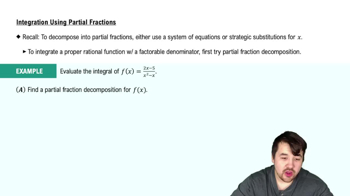
∑⁽∞⁾ₖ₌₁2⁄[(2k − 1)(2k + 1)]

 Verified step by step guidance
 06:00
06:00
 08:01
08:01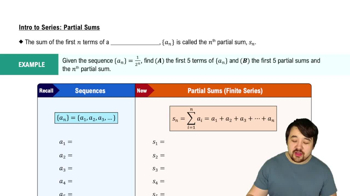 06:45
06:4567–70. Formulas for sequences of partial sums Consider the following infinite series.
c.Make a conjecture for the value of the series.
∑⁽∞⁾ₖ₌₁2⁄[(2k − 1)(2k + 1)]
{Use of Tech} A savings plan
James begins a savings plan in which he deposits \(100 at the beginning of each month into an account that earns 9% interest annually, or equivalently, 0.75% per month.
To be clear, on the first day of each month, the bank adds 0.75% of the current balance as interest, and then James deposits \)100.
Let Bₙ be the balance in the account after the nᵗʰ payment, where B₀ = \(0.
c.How many months are needed to reach a balance of \)5000?
Explain why or why not Determine whether the following statements are true and give an explanation or counterexample.
c. A series that converges conditionally must converge.
Explain why or why not Determine whether the following statements are true and give an explanation or counterexample.
c. If lim (as k → ∞) ᵏ√|aₖ| = 1/4, then ∑ 10aₖ converges absolutely.
Explain why or why not
Determine whether the following statements are true and give an explanation or counterexample.
c.If the terms of the sequence {aₙ} are positive and increasing, then the sequence of partial sums for the series∑⁽∞⁾ₖ₌₁aₖ diverges.
87. Explain why or why not
Determine whether the following statements are true and give an explanation or counterexample.
c. If ∑ aₖ converges, then ∑ (aₖ + 0.0001) converges.