
Ch. 10 - Sequences and Infinite Series
Briggs - Calculus: Early Transcendentals 3rd Edition
Briggs3rd EditionCalculus: Early TranscendentalsISBN: 9780136847243Not the one you use?Change textbook
Chapter 10, Problem 10.1.67c

67–70. Formulas for sequences of partial sums Consider the following infinite series.


c.Make a conjecture for the value of the series.


∑⁽∞⁾ₖ₌₁2⁄[(2k − 1)(2k + 1)]

Verified step by step guidance
1
Start by examining the general term of the series: \(\frac{2}{(2k - 1)(2k + 1)}\). The goal is to simplify this term to identify a pattern or telescoping behavior.
Use partial fraction decomposition to rewrite the term. Set up the equation: \(\frac{2}{(2k - 1)(2k + 1)} = \frac{A}{2k - 1} + \frac{B}{2k + 1}\), and solve for constants \(A\) and \(B\).
After finding \(A\) and \(B\), express the general term as the difference of two simpler fractions, which will help in telescoping the series when summed from \(k=1\) to \(n\).
Write the partial sum \(S_n = \sum_{k=1}^n \frac{2}{(2k - 1)(2k + 1)}\) using the decomposed form, and observe how most terms cancel out when expanded.
Identify the remaining terms after cancellation to find a formula for \(S_n\), then take the limit as \(n \to \infty\) to conjecture the value of the infinite series.

Verified video answer for a similar problem:

This video solution was recommended by our tutors as helpful for the problem above.
Video duration:
4m
Was this helpful?

Key Concepts

Here are the essential concepts you must grasp in order to answer the question correctly.

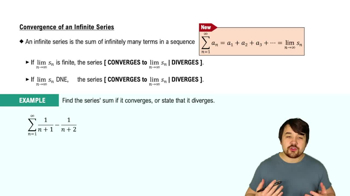
Infinite Series and Convergence

An infinite series is the sum of infinitely many terms. To find its value, we must determine if the series converges, meaning its partial sums approach a finite limit. Understanding convergence is essential before assigning a sum to an infinite series.
Recommended video:
06:52
Convergence of an Infinite Series

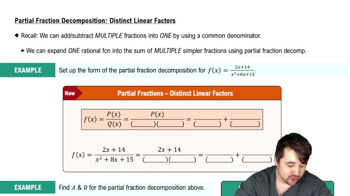
Partial Fraction Decomposition

Partial fraction decomposition breaks a complex rational expression into simpler fractions. This technique helps simplify terms in the series, making it easier to identify patterns or telescoping behavior that can lead to a closed-form sum.
Recommended video:
10:07
Partial Fraction Decomposition: Distinct Linear Factors

Telescoping Series

A telescoping series is one where many terms cancel out when partial sums are expanded. Recognizing telescoping allows us to simplify the sum of the series by focusing on the first and last terms of the partial sums, facilitating the evaluation of the infinite sum.
Recommended video:
06:00
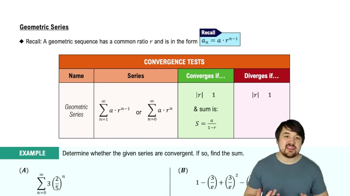
Geometric Series