
Ch. 10 - Sequences and Infinite Series
Briggs - Calculus: Early Transcendentals 3rd Edition
Briggs3rd EditionCalculus: Early TranscendentalsISBN: 9780136847243Not the one you use?Change textbook
Chapter 10, Problem 10.4.43b

41–44. {Use of Tech} Remainders and estimates Consider the following convergent series.


b. Find how many terms are needed to ensure that the remainder is less than 10⁻³.


43. ∑ (k = 1 to ∞) 1 / 3ᵏ

Verified step by step guidance
1
Identify the series given: it is a geometric series with the general term \( a_k = \frac{1}{3^k} \).
Recall that for a geometric series \( \sum_{k=1}^\infty ar^{k-1} \), the sum to infinity is \( \frac{a}{1-r} \) if \( |r| < 1 \). Here, the first term \( a = \frac{1}{3} \) and common ratio \( r = \frac{1}{3} \).
The remainder \( R_n \) after summing the first \( n \) terms is the sum of the terms from \( n+1 \) to infinity. For a geometric series, \( R_n = \frac{a r^n}{1-r} \). In this problem, \( R_n = \frac{\frac{1}{3} \left( \frac{1}{3} \right)^n}{1 - \frac{1}{3}} \).
Simplify the expression for \( R_n \) to get a formula in terms of \( n \): \( R_n = \frac{\frac{1}{3^{n+1}}}{1 - \frac{1}{3}} = \frac{\frac{1}{3^{n+1}}}{\frac{2}{3}} = \frac{1}{2 \cdot 3^n} \).
Set the remainder \( R_n \) less than \( 10^{-3} \) and solve the inequality \( \frac{1}{2 \cdot 3^n} < 10^{-3} \) for \( n \) to find the minimum number of terms needed.

Verified video answer for a similar problem:

This video solution was recommended by our tutors as helpful for the problem above.
Video duration:
5m
Was this helpful?

Key Concepts

Here are the essential concepts you must grasp in order to answer the question correctly.

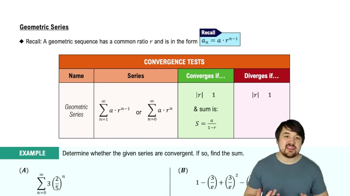
Geometric Series

A geometric series is a sum of terms where each term is found by multiplying the previous term by a constant ratio. For |r| < 1, the infinite series converges to a finite sum S = a / (1 - r), where a is the first term. Understanding this helps identify the sum and behavior of the series ∑ 1/3^k.
Recommended video:
06:00
Geometric Series

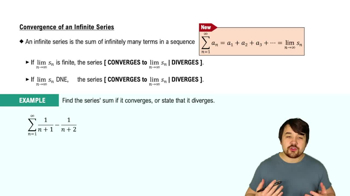
Remainder (Error) in Infinite Series

The remainder after n terms in a convergent series is the difference between the infinite sum and the partial sum up to n terms. For geometric series, the remainder can be explicitly calculated as R_n = S - S_n = a * r^n / (1 - r), which helps estimate how many terms are needed to achieve a desired accuracy.
Recommended video:
06:52
Convergence of an Infinite Series

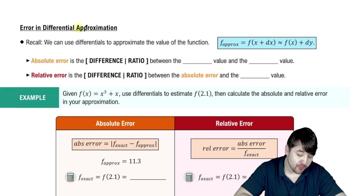
Convergence Criteria and Error Bounds

To ensure the remainder is less than a specified tolerance (e.g., 10⁻³), one must use the error bound formula for the series. This involves solving inequalities involving the remainder expression to find the minimum number of terms n that satisfy the accuracy requirement.
Recommended video:
04:57
Determining Error and Relative Error