
Ch. 10 - Sequences and Infinite Series
Briggs - Calculus: Early Transcendentals 3rd Edition
Briggs3rd EditionCalculus: Early TranscendentalsISBN: 9780136847243Not the one you use?Change textbook
Chapter 10, Problem 10.1.29b

27–34. Working with sequences Several terms of a sequence {aₙ}ₙ₌₁∞ are given.
b. Find a recurrence relation that generates the sequence (supply the initial value of the index and the first term of the sequence).


{1, 2, 4, 8, 16, ......}

Verified step by step guidance
1
Observe the given sequence: {1, 2, 4, 8, 16, ...}. Notice the pattern in how each term relates to the previous term.
Identify the relationship between consecutive terms. For example, check how to get from 1 to 2, from 2 to 4, and so on. This will help you find the recurrence relation.
Express the recurrence relation in the form \(a_{n} = f(a_{n-1})\), where \(a_{n}\) is the current term and \(a_{n-1}\) is the previous term. Based on the pattern, determine the function \(f\).
Specify the initial index value, usually \(n=1\), and state the first term of the sequence \(a_1\) explicitly.
Write the complete recurrence relation including the initial condition, for example: \(a_1 = 1\) and \(a_n = 2 \times a_{n-1}\) for \(n \geq 2\).

Verified video answer for a similar problem:

This video solution was recommended by our tutors as helpful for the problem above.
Video duration:
2m
Was this helpful?

Key Concepts

Here are the essential concepts you must grasp in order to answer the question correctly.

Sequences and Terms

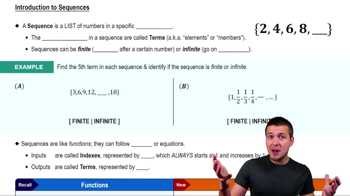
A sequence is an ordered list of numbers defined by a specific rule. Each number in the sequence is called a term, typically denoted as aₙ, where n indicates the term's position. Understanding how terms progress helps identify patterns or formulas.
Recommended video:
Guided course
8:22
Introduction to Sequences

Recurrence Relations

A recurrence relation expresses each term of a sequence as a function of one or more previous terms. It provides a way to generate the sequence step-by-step, starting from initial term(s). For example, aₙ = 2aₙ₋₁ defines each term as twice the previous term.
Recommended video:
04:16
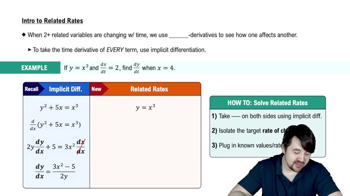
Intro To Related Rates

Initial Conditions

Initial conditions specify the starting term(s) of a sequence, which are necessary to uniquely determine all subsequent terms using a recurrence relation. Without these values, the sequence cannot be fully generated or identified.
Recommended video:
05:03
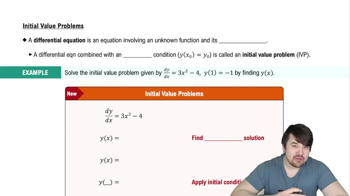
Initial Value Problems
Related Practice
Textbook Question

67–70. Formulas for sequences of partial sums Consider the following infinite series.


b.Find a formula for the nth partial sum Sₙ of the infinite series. Use this formula to find the next four partial sums S₅, S₆, S₇, S₈ of the infinite series.


∑⁽∞⁾ₖ₌₁2⁄[(2k − 1)(2k + 1)]

Textbook Question

41–44. {Use of Tech} Remainders and estimates Consider the following convergent series.


b. Find how many terms are needed to ensure that the remainder is less than 10⁻³.


43. ∑ (k = 1 to ∞) 1 / 3ᵏ

Textbook Question

{Use of Tech} A savings plan

James begins a savings plan in which he deposits \(100 at the beginning of each month into an account that earns 9% interest annually, or equivalently, 0.75% per month.

To be clear, on the first day of each month, the bank adds 0.75% of the current balance as interest, and then James deposits \)100.


Let Bₙ be the balance in the account after the nᵗʰ payment, where B₀ = \$0.


b.Find a recurrence relation that generates the sequence {Bₙ}.

1
views
Textbook Question

57–60. Heights of bouncing balls A ball is thrown upward to a height of hₒ meters. After each bounce, the ball rebounds to a fraction r of its previous height. Let hₙ be the height after the nth bounce. Consider the following values of hₒ and r.


b. Find an explicit formula for the nth term of the sequence {hₙ}.


h₀ = 20,r = 0.5

1
views
Textbook Question

18–20. Evaluating geometric series two ways Evaluate each geometric series two ways.


b. Evaluate the series using Theorem 10.7.


∑ (k = 0 to ∞) (–2/7)ᵏ

Textbook Question

72–75. {Use of Tech} Practical sequences

Consider the following situations that generate a sequence


b.Find an explicit formula for the terms of the sequence.


Radioactive decay

A material transmutes 50% of its mass to another element every 10 years due to radioactive decay. Let Mₙ be the mass of the radioactive material at the end of the nᵗʰ decade, where the initial mass of the material is M₀ = 20g.

1
views