Ch. 1 - Functions
Briggs - Calculus: Early Transcendentals 3rd Edition
Briggs3rd EditionCalculus: Early TranscendentalsISBN: 9780136847243Not the one you use?Change textbook
Chapter 1, Problem 77g

Explain why or why not Determine whether the following statements are true and give an explanation or counterexample.


If f(x)=1xf\(\left\)(x\(\right\))=\(\frac{1}{x}\) , then f1(x)=1xf^{-1}\(\left\)(x\(\right\))=\(\frac{1}{x}\)

Verified step by step guidance
1
Step 1: Understand the problem statement. We are given a function \( f(x) = \frac{1}{x} \) and need to determine if its inverse \( f^{-1}(x) \) is also \( \frac{1}{x} \).
Step 2: Recall the definition of an inverse function. For a function \( f(x) \), its inverse \( f^{-1}(x) \) satisfies the condition \( f(f^{-1}(x)) = x \) and \( f^{-1}(f(x)) = x \).
Step 3: Apply the inverse function condition to \( f(x) = \frac{1}{x} \). Assume \( f^{-1}(x) = \frac{1}{x} \) and check if \( f(f^{-1}(x)) = x \). Substitute \( f^{-1}(x) \) into \( f(x) \): \( f(f^{-1}(x)) = f\left(\frac{1}{x}\right) = \frac{1}{\left(\frac{1}{x}\right)} = x \). This condition holds.
Step 4: Check the second condition \( f^{-1}(f(x)) = x \). Substitute \( f(x) \) into \( f^{-1}(x) \): \( f^{-1}(f(x)) = f^{-1}\left(\frac{1}{x}\right) = \frac{1}{\left(\frac{1}{x}\right)} = x \). This condition also holds.
Step 5: Conclude that both conditions for inverse functions are satisfied, so the statement is true. The inverse of \( f(x) = \frac{1}{x} \) is indeed \( f^{-1}(x) = \frac{1}{x} \).

Verified video answer for a similar problem:

This video solution was recommended by our tutors as helpful for the problem above.
Video duration:
2m
Was this helpful?

Key Concepts

Here are the essential concepts you must grasp in order to answer the question correctly.

Function and Inverse Function

A function maps each input to a single output, while an inverse function reverses this mapping. For a function f(x), the inverse f^{-1}(x) satisfies the condition f(f^{-1}(x)) = x for all x in the domain of f^{-1}. Understanding this relationship is crucial for determining whether the given statement about f(x) and its inverse is true.
Recommended video:
06:35
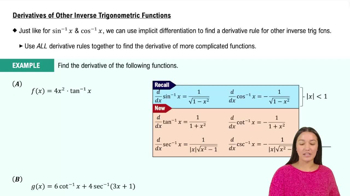
Derivatives of Other Inverse Trigonometric Functions

Domain and Range

The domain of a function is the set of all possible input values, while the range is the set of all possible output values. For the function f(x) = 1/x, the domain excludes zero, as division by zero is undefined. When analyzing the inverse function, it is essential to consider how the domain and range of f affect those of f^{-1}.
Recommended video:
5:10
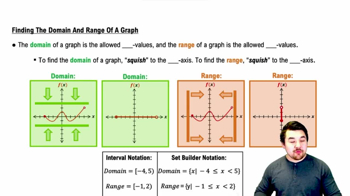
Finding the Domain and Range of a Graph

Counterexamples

A counterexample is a specific case that disproves a general statement. In the context of functions and their inverses, providing a counterexample involves finding a value for which the proposed relationship does not hold. This is a critical skill in calculus, as it helps clarify the conditions under which statements about functions and their inverses are valid.