Ch. 1 - Functions
Briggs - Calculus: Early Transcendentals 3rd Edition
Briggs3rd EditionCalculus: Early TranscendentalsISBN: 9780136847243Not the one you use?Change textbook
Chapter 1, Problem 77d

Determine whether the following statements are true and give an explanation or counterexample.


2=10log1022=10^{\(\log\)_{10}2}

Verified step by step guidance
1
Step 1: Understand the statement. The statement given is 2 = 10^{\(\log\)_{10}2}.
Step 2: Recall the property of logarithms. One important property is that if a = b^{\(\log\)_b(a)}, then the statement is true.
Step 3: Apply the property to the given statement. Here, a = 2 and b = 10, so we have 2 = 10^{\(\log\)_{10}(2)}.
Step 4: Verify the property. Since the base of the logarithm (10) and the base of the exponent (10) are the same, the property holds true.
Step 5: Conclude that the statement is true based on the logarithmic property.

Verified video answer for a similar problem:

This video solution was recommended by our tutors as helpful for the problem above.
Video duration:
1m
Was this helpful?

Key Concepts

Here are the essential concepts you must grasp in order to answer the question correctly.

Logarithmic Identity

The logarithmic identity states that for any positive number 'a' and 'b', the equation a = b^log_b(a) holds true. This means that raising the base 'b' to the logarithm of 'a' with base 'b' will yield 'a'. This identity is fundamental in understanding how logarithms relate to exponentiation and is crucial for evaluating expressions involving logarithms.
Recommended video:
7:17
Verifying Trig Equations as Identities

Properties of Logarithms

Logarithms have several key properties that simplify calculations, such as the product, quotient, and power rules. For instance, log_b(xy) = log_b(x) + log_b(y) and log_b(x/y) = log_b(x) - log_b(y). Understanding these properties allows for the manipulation of logarithmic expressions, which is essential for verifying the truth of statements involving logarithms.
Recommended video:
05:36
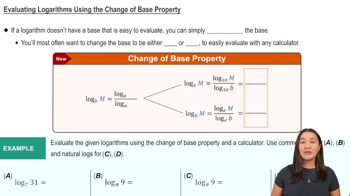
Change of Base Property

Base of a Logarithm

The base of a logarithm is the number that is raised to a power to obtain a given number. In the expression log_b(a), 'b' is the base. Different bases can yield different results, and it is important to recognize that the base must be positive and not equal to one. This concept is critical when evaluating logarithmic expressions and understanding their implications in equations.
Recommended video:
05:36
Change of Base Property
Related Practice
Textbook Question

Determine whether the following statements are true and give an explanation or counterexample.


2=ln2e2=\(\ln\)2^{e}

4
views
Textbook Question

Determine whether the following statements are true and give an explanation or counterexample.

log546=4log56\(\log\)_54^6=4\(\log\)_56

3
views
Textbook Question

Explain why or why not Determine whether the following statements are true and give an explanation or counterexample.


If f(x)=1xf\(\left\)(x\(\right\))=\(\frac{1}{x}\) , then f1(x)=1xf^{-1}\(\left\)(x\(\right\))=\(\frac{1}{x}\)

Textbook Question

Determine whether the following statements are true and give an explanation or counterexample.


logbxlogby=logbxlogby\(\frac{\log_{b}\)x}{\(\log\)_{b}y}=\(\log\)_{b}x-\(\log\)_{b}y

Textbook Question

In each exercise, a function and an interval of its independent variable are given. The endpoints of the interval are associated with points PP and QQ on the graph of the function.

a. Sketch a graph of the function and the secant line through PP and QQ.

b. Find the slope of the secant line in part (a), and interpret your answer in terms of an average rate of change over the interval. Include units in your answer.

After tt seconds, an object dropped from rest falls a distance d=16t2d=16t^2, where dd is measured in feet and 2t52\(\leq{t}\]\leq{5}\).

1
views
Textbook Question

Explain why or why not Determine whether the following statements are true and give an explanation or counterexample.


If f(x)=x2+1f\(\left\)(x\(\right\))=x^2+1 , then f1(x)=1x2+1f^{-1}\(\left\)(x\(\right\))=\(\frac{1}{x^2+1}\).

8
views