Ch. 1 - Functions
Briggs - Calculus: Early Transcendentals 3rd Edition
Briggs3rd EditionCalculus: Early TranscendentalsISBN: 9780136847243Not the one you use?Change textbook
Chapter 1, Problem 77e

Determine whether the following statements are true and give an explanation or counterexample.


2=ln2e2=\(\ln\)2^{e}

Verified step by step guidance
1
Step 1: Start by analyzing the given equation: \( 2 = \ln(2^e) \).
Step 2: Recall the logarithmic identity \( \ln(a^b) = b \cdot \ln(a) \).
Step 3: Apply the identity to the right side of the equation: \( \ln(2^e) = e \cdot \ln(2) \).
Step 4: Substitute back into the equation: \( 2 = e \cdot \ln(2) \).
Step 5: Solve for \( e \) by dividing both sides by \( \ln(2) \): \( e = \frac{2}{\ln(2)} \).

Verified video answer for a similar problem:

This video solution was recommended by our tutors as helpful for the problem above.
Video duration:
1m
Was this helpful?

Key Concepts

Here are the essential concepts you must grasp in order to answer the question correctly.

Natural Logarithm

The natural logarithm, denoted as ln, is the logarithm to the base e, where e is approximately 2.71828. It is a fundamental concept in calculus, particularly in relation to exponential functions. The natural logarithm has properties that make it useful for solving equations involving exponential growth or decay, and it is often used in integration and differentiation.
Recommended video:
05:18
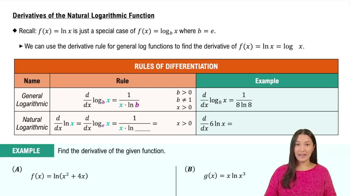
Derivative of the Natural Logarithmic Function

Exponential Functions

Exponential functions are mathematical functions of the form f(x) = a * e^(bx), where a and b are constants, and e is the base of the natural logarithm. These functions exhibit rapid growth or decay and are characterized by their constant percentage rate of change. Understanding exponential functions is crucial for analyzing growth models, compound interest, and natural phenomena.
Recommended video:
6:13
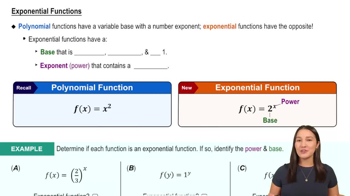
Exponential Functions

Equality of Functions

To determine if two expressions are equal, one must evaluate both sides under the same conditions. In calculus, this often involves substituting values or simplifying expressions. For the statement 2 = ln(2^e), one must understand how to manipulate logarithmic identities and evaluate the left and right sides to verify their equality or find a counterexample.
Recommended video:
6:13
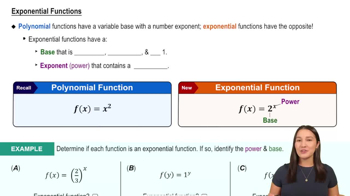
Exponential Functions