
Textbook Question
Composite functions
Let ƒ(x) = x³, g (x) = sin x and h(x) = √x .
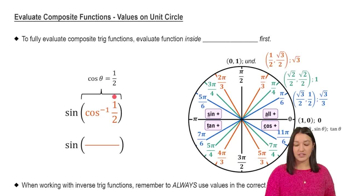
Evaluate h(g( π/2)).

 Verified step by step guidance
 5:10
5:10
 8:22
8:22 5:53
5:53Composite functions
Let ƒ(x) = x³, g (x) = sin x and h(x) = √x .
Evaluate h(g( π/2)).
Use the table to evaluate the given compositions. <IMAGE>
ƒ(ƒ(h(3)))
Find the linear function whose graph passes through the point (3, 2) and is parallel to the line .
Composite functions
Let ƒ(x) = x³, g (x) = sin x and h(x) = √x .
Find h (ƒ (x)).
Composite functions
Let ƒ(x) = x³, g (x) = sin x and h(x) = √x.
Find ƒ(g(h( x))).
Yeast growth Consider a colony of yeast cells that has the shape of a cylinder. As the number of yeast cells increases, the cross-sectional area A (in mm²) of the colony increases but the height of the colony remains constant. If the colony starts from a single cell, the number of yeast cells (in millions) is approximated by the linear function N(A) - CₛA, where the constant Cₛ is known as the cell-surface coefficient. Use the given information to determine the cell-surface coefficient for each of the following colonies of yeast cells, and find the number of yeast cells in the colony when the cross-sectional area A reaches 150 mm². (Source: Letters in Applied Microbiology, 594, 59, 2014)
The scientific name of baker’s or brewer’s yeast (used in making bread, wine, and beer) is Saccharomyces cerevisiae. When the cross-sectional area of a colony of this yeast reaches 100 mm², there are 571 million yeast cells.