Ch. 1 - Functions
Briggs - Calculus: Early Transcendentals 3rd Edition
Briggs3rd EditionCalculus: Early TranscendentalsISBN: 9780136847243Not the one you use?Change textbook
Chapter 1, Problem 19a

Composite functions
Let ƒ(x) = x³, g (x) = sin x and h(x) = √x .
Evaluate h(g( π/2)).

Verified step by step guidance
1
Identify the innermost function in the composite function h(g(\(\pi\)/2)).
Evaluate g(\(\pi\)/2) by substituting \(\pi\)/2 into the function g(x) = \(\sin\) x.
Calculate \(\sin\)(\(\pi\)/2) to find the value of g(\(\pi\)/2).
Substitute the result of g(\(\pi\)/2) into the function h(x) = \(\sqrt{x}\).
Evaluate h(g(\(\pi\)/2)) by calculating \(\sqrt\){g(\(\pi\)/2)).

Verified video answer for a similar problem:

This video solution was recommended by our tutors as helpful for the problem above.
Video duration:
3m
Was this helpful?

Key Concepts

Here are the essential concepts you must grasp in order to answer the question correctly.

Composite Functions

Composite functions are formed when one function is applied to the result of another function. In mathematical notation, if you have two functions f(x) and g(x), the composite function is denoted as (f ∘ g)(x) = f(g(x)). Understanding how to evaluate composite functions is crucial for solving problems that involve multiple functions.
Recommended video:
3:48
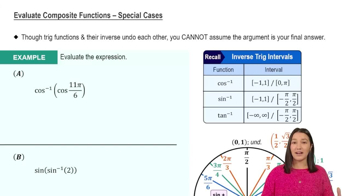
Evaluate Composite Functions - Special Cases

Function Evaluation

Function evaluation involves substituting a specific input value into a function to obtain an output. For example, if f(x) = x³, then f(2) = 2³ = 8. In the context of composite functions, you first evaluate the inner function and then use that result as the input for the outer function, which is essential for solving the given problem.
Recommended video:
4:26
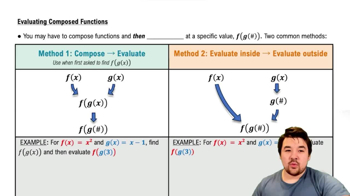
Evaluating Composed Functions

Trigonometric Functions

Trigonometric functions, such as sine (sin), are fundamental in calculus and relate angles to ratios of sides in right triangles. The function g(x) = sin x outputs the sine of the angle x, which is crucial for evaluating composite functions that involve trigonometric expressions. Understanding the properties and values of these functions, especially at key angles, is important for accurate calculations.
Recommended video:
6:04
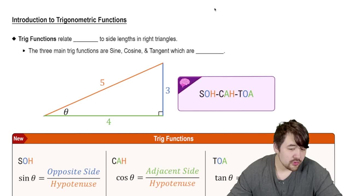
Introduction to Trigonometric Functions
Related Practice
Textbook Question

Evaluating trigonometric functions Without using a calculator, evaluate the following expressions or state that the quantity is undefined.


cos (2π/3)

1
views

Textbook Question

Find the linear function whose graph passes through the point (3, 2) and is parallel to the line y=3x+8y= 3x + 8 .

Textbook Question

Composite functions

Let ƒ(x) = x³, g (x) = sin x and h(x) = √x.

Find the domain of g o ƒ.

Textbook Question

Composite functions

Let ƒ(x) = x³, g (x) = sin x and h(x) = √x .

Find h (ƒ (x)).

Textbook Question

Composite functions

Let ƒ(x) = x³, g (x) = sin x and h(x) = √x.

Find ƒ(g(h( x))).

Textbook Question

Yeast growth Consider a colony of yeast cells that has the shape of a cylinder. As the number of yeast cells increases, the cross-sectional area A (in mm²) of the colony increases but the height of the colony remains constant. If the colony starts from a single cell, the number of yeast cells (in millions) is approximated by the linear function N(A) - CₛA, where the constant Cₛ is known as the cell-surface coefficient. Use the given information to determine the cell-surface coefficient for each of the following colonies of yeast cells, and find the number of yeast cells in the colony when the cross-sectional area A reaches 150 mm². (Source: Letters in Applied Microbiology, 594, 59, 2014)

The scientific name of baker’s or brewer’s yeast (used in making bread, wine, and beer) is Saccharomyces cerevisiae. When the cross-sectional area of a colony of this yeast reaches 100 mm², there are 571 million yeast cells.

2
views