Ch. 1 - Functions
Briggs - Calculus: Early Transcendentals 3rd Edition
Briggs3rd EditionCalculus: Early TranscendentalsISBN: 9780136847243Not the one you use?Change textbook
Chapter 1, Problem 19c

Composite functions
Let ƒ(x) = x³, g (x) = sin x and h(x) = √x.
Find ƒ(g(h( x))).

Verified step by step guidance
1
Identify the innermost function in the composite function \( f(g(h(x))) \). Here, it is \( h(x) = \sqrt{x} \).
Substitute \( h(x) \) into \( g(x) \), resulting in \( g(h(x)) = g(\sqrt{x}) = \sin(\sqrt{x}) \).
Now, substitute \( g(h(x)) \) into \( f(x) \), resulting in \( f(g(h(x))) = f(\sin(\sqrt{x})) \).
Since \( f(x) = x^3 \), replace \( x \) with \( \sin(\sqrt{x}) \) to get \( (\sin(\sqrt{x}))^3 \).
Thus, the expression for \( f(g(h(x))) \) is \( (\sin(\sqrt{x}))^3 \).

Verified video answer for a similar problem:

This video solution was recommended by our tutors as helpful for the problem above.
Video duration:
2m
Was this helpful?

Key Concepts

Here are the essential concepts you must grasp in order to answer the question correctly.

Composite Functions

Composite functions are formed when one function is applied to the result of another function. In mathematical notation, if you have two functions f(x) and g(x), the composite function f(g(x)) means you first apply g to x, and then apply f to the result of g. Understanding how to combine functions is essential for solving problems involving multiple functions.
Recommended video:
3:48
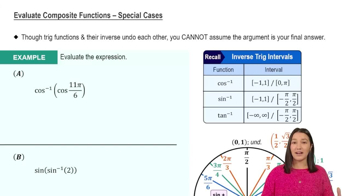
Evaluate Composite Functions - Special Cases

Function Notation

Function notation is a way to represent functions and their operations clearly. For example, f(x) denotes a function f evaluated at x. This notation helps in understanding how to manipulate and combine functions, especially when dealing with compositions like f(g(h(x))). Recognizing how to read and interpret these notations is crucial for solving calculus problems.
Recommended video:
7:24
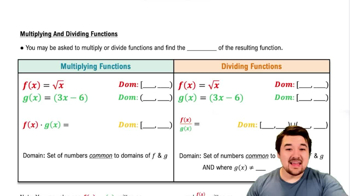
Multiplying & Dividing Functions

Basic Functions

Basic functions such as polynomial functions, trigonometric functions, and root functions form the foundation of calculus. In this question, f(x) = x³ is a polynomial function, g(x) = sin x is a trigonometric function, and h(x) = √x is a root function. Knowing the properties and behaviors of these functions is vital for accurately performing operations like composition.
Recommended video:
05:28
Integrals Resulting in Basic Trig Functions