Ch. 6 - Applications of Definite Integrals
Hass - Thomas' Calculus 15th Edition
Hass15th EditionThomas' CalculusISBN: 9780137616077Not the one you use?Change textbook
Chapter 6, Problem 6.PE.27

Work


Lifting equipment A rock climber is about to haul up 100 N (about 22.5 lb) of equipment that has been hanging beneath her on 40 m of rope that weighs 0.8 N/m. How much work will it take? (Hint: Solve for the rope and equipment separately, then add.)

Verified step by step guidance
1
Identify the two components of the work to be done: the work to lift the rock climber's equipment (100 N) and the work to lift the rope itself, which has weight distributed along its length.
Calculate the work done to lift the equipment. Since the equipment weighs 100 N and is lifted a distance of 40 m, the work done on the equipment is given by the formula \(W_{equipment} = F \times d\), where \(F = 100\) N and \(d = 40\) m.
For the rope, recognize that its weight is distributed uniformly along its length, with a linear weight density of 0.8 N/m. The total weight of the rope is \(0.8 \times 40\) N, but since the rope is lifted gradually, the force varies with the length lifted.
Set up an integral to calculate the work done lifting the rope. Let \(x\) represent the length of rope lifted at any moment (from 0 to 40 m). The weight of the rope segment being lifted at position \(x\) is \(0.8 \times (40 - x)\) N, and the distance it is lifted is \(x\) meters. The work done on a small segment \(dx\) is \(dW = 0.8 \times (40 - x) \times dx\).
Integrate the expression for \(dW\) from \(x=0\) to \(x=40\) to find the total work done lifting the rope: \(W_{rope} = \int_0^{40} 0.8 \times (40 - x) \, dx\). Finally, add the work done lifting the equipment and the work done lifting the rope to find the total work.

Verified video answer for a similar problem:

This video solution was recommended by our tutors as helpful for the problem above.
Video duration:
7m
Was this helpful?

Key Concepts

Here are the essential concepts you must grasp in order to answer the question correctly.

Work Done by a Force

Work is the product of force and displacement in the direction of the force. When lifting an object vertically, work equals the weight (force due to gravity) multiplied by the height lifted. This concept helps calculate the energy required to raise the equipment and rope.
Recommended video:
05:40
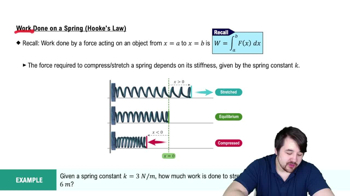
Work Done On A Spring (Hooke's Law)

Variable Force Due to Rope Weight

The rope’s weight is distributed along its length, so the force needed to lift it varies with height. At any point, the force equals the weight of the rope segment still hanging below. This requires integrating the force over the rope’s length to find total work.
Recommended video:
09:32
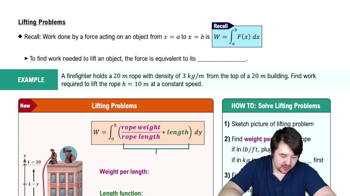
Lifting Problems

Integration to Calculate Work with Variable Force

When force changes with position, work is found by integrating the force function over the displacement interval. For the rope, this means integrating the weight per unit length times the length lifted, allowing calculation of total work done lifting the rope.
Recommended video:
06:22
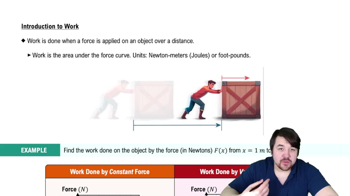
Introduction To Work