Ch. 6 - Applications of Definite Integrals
Hass - Thomas' Calculus 15th Edition
Hass15th EditionThomas' CalculusISBN: 9780137616077Not the one you use?Change textbook
Chapter 6, Problem 6.PE.10d

Volumes
Find the volume of the solid generated by revolving the region bounded by the parabola y² = 4x and the line y = x about
d. the line y = 4

Verified step by step guidance
1
First, identify the region bounded by the curves. The parabola is given by \(y^{2} = 4x\), which can be rewritten as \(x = \frac{y^{2}}{4}\). The line is \(y = x\). To find the limits of integration, find the points of intersection by solving \(y = x\) and \(y^{2} = 4x\) simultaneously.
Set \(y = x\) into the parabola equation: \(y^{2} = 4y\). This simplifies to \(y^{2} - 4y = 0\), or \(y(y - 4) = 0\). So, the intersection points are at \(y = 0\) and \(y = 4\). These will be the bounds for integration.
Since the solid is generated by revolving the region about the line \(y = 4\), use the method of washers (disks with holes). For a given \(y\) between 0 and 4, the outer radius \(R(y)\) and inner radius \(r(y)\) are the distances from the line \(y=4\) to the curves.
Calculate the outer radius \(R(y)\) as the distance from \(y=4\) to the curve closer to the axis of revolution. The outer radius corresponds to the line \(y = x\), so \(R(y) = 4 - y\). The inner radius corresponds to the parabola \(x = \frac{y^{2}}{4}\), so express \(x\) in terms of \(y\) and find the horizontal distance to the axis of revolution. Since the axis is horizontal, the radius is vertical distance, so for the parabola, the radius is \(4 - y\) as well, but we need to consider the \(x\)-values to find the horizontal boundaries.
Because the axis of revolution is horizontal (\(y=4\)), and the region is bounded between the curves in the \(xy\)-plane, it is easier to express \(x\) in terms of \(y\) and use the shell method. The shell radius is the distance from \(y\) to \(4\), which is \(4 - y\), and the shell height is the horizontal distance between the curves, which is \(x_{right} - x_{left} = y - \frac{y^{2}}{4}\). Set up the volume integral using the shell method: \(V = 2\pi \int_{0}^{4} (4 - y) \left(y - \frac{y^{2}}{4}\right) dy\).

Verified video answer for a similar problem:

This video solution was recommended by our tutors as helpful for the problem above.
Video duration:
10m
Was this helpful?

Key Concepts

Here are the essential concepts you must grasp in order to answer the question correctly.

Setting up the region bounded by curves

To find the volume of a solid of revolution, first identify the region bounded by the given curves. Here, the parabola y² = 4x and the line y = x intersect, defining the limits of integration. Understanding how to find their points of intersection and the area enclosed is essential for setting up the integral.
Recommended video:
05:23
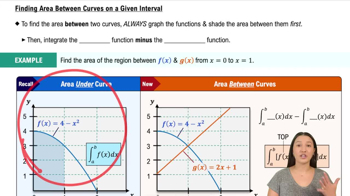
Finding Area Between Curves on a Given Interval

Method of cylindrical shells or washers for volumes of revolution

Volumes generated by revolving a region around a line can be found using the washer or shell method. The washer method involves slicing perpendicular to the axis of rotation, creating disks or washers, while the shell method uses cylindrical shells parallel to the axis. Choosing the appropriate method simplifies the integral setup.
Recommended video:
04:48
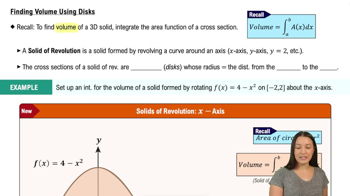
Finding Volume Using Disks

Adjusting for axis of rotation not on coordinate axes

When revolving around a line other than the x- or y-axis, such as y = 4, distances from the region to the axis must be adjusted accordingly. This affects the radius in the volume formula, requiring careful calculation of the outer and inner radii relative to the line y = 4 to correctly set up the integral.
Recommended video:
3:00
Determining Different Coordinates for the Same Point Example 2