
Ch. 6 - Applications of Definite Integrals
Hass - Thomas' Calculus 15th Edition
Hass15th EditionThomas' CalculusISBN: 9780137616077Not the one you use?Change textbook
Chapter 6, Problem 6.PE.7a

Volumes
Find the volume of the solid generated by revolving the region bounded by the x-axis, the curve y = 3x⁴ , and the lines x = 1 and x = ―1 about
a. the x-axis

Verified step by step guidance
1
Identify the region bounded by the curves: the x-axis (y = 0), the curve y = 3x^{4}, and the vertical lines x = -1 and x = 1. This region lies between x = -1 and x = 1 and above the x-axis.
Since the solid is generated by revolving the region about the x-axis, use the disk method to find the volume. The volume of a solid of revolution about the x-axis is given by the integral: \[ V = \pi \int_{a}^{b} [f(x)]^{2} \, dx \] where \(f(x)\) is the function representing the curve, and \(a\) and \(b\) are the bounds of integration.
Substitute the function and bounds into the formula. Here, \(f(x) = 3x^{4}\), \(a = -1\), and \(b = 1\), so the volume integral becomes: \[ V = \pi \int_{-1}^{1} (3x^{4})^{2} \, dx \]
Simplify the integrand inside the integral: \[ (3x^{4})^{2} = 9x^{8} \] So the integral becomes: \[ V = \pi \int_{-1}^{1} 9x^{8} \, dx \]
Evaluate the integral by integrating \$9x^{8}\( with respect to \)x\( over the interval \)[-1, 1]$. After finding the antiderivative, apply the Fundamental Theorem of Calculus to compute the definite integral, then multiply by \(\pi\) to find the volume.

Verified video answer for a similar problem:

This video solution was recommended by our tutors as helpful for the problem above.
Video duration:
2m
Was this helpful?

Key Concepts

Here are the essential concepts you must grasp in order to answer the question correctly.

Volume of Solids of Revolution

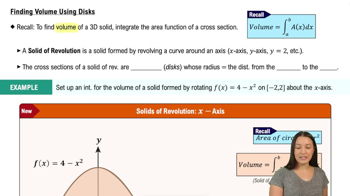
This concept involves finding the volume of a 3D solid formed by rotating a 2D region around an axis. The volume is typically calculated using integral calculus, where the shape is sliced into thin disks or washers perpendicular to the axis of rotation.
Recommended video:
04:48
Finding Volume Using Disks

Disk Method

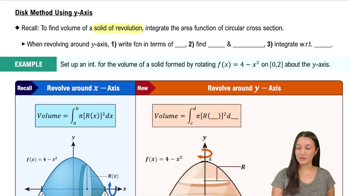
The disk method calculates volume by summing up the volumes of infinitesimally thin circular disks formed when the region is revolved around an axis. Each disk's volume is π(radius)^2 times its thickness, and the radius is given by the function value at each x.
Recommended video:
06:30
Disk Method Using y-Axis

Setting up Definite Integrals with Boundaries

To find the volume, you must correctly identify the limits of integration and the function defining the radius. Here, the region is bounded by x = -1 and x = 1, and the radius is given by y = 3x^4, which determines the size of each disk when revolving around the x-axis.
Recommended video:
05:43
Definition of the Definite Integral
Related Practice
Textbook Question

Work

Pumping a conical tank A right-circular conical tank, point down, with top radius 5 ft and height 10 ft, is filled with a liquid whose weight-density is 60lb/ft³. How much work does it take to pump the liquid to a point 2 ft above the tank? If the pump is driven by a motor rated at 275ft-lb/sec (1/2 hp), how long will it take to empty the tank? 

1
views
Textbook Question

Centers of Mass and Centroids

Find the center of mass of a thin, flat plate covering the region enclosed by the parabola 𝔂² = 𝓍 and the line 𝓍 = 2𝔂 if the density function is δ(𝔂) = 1 + 𝔂. (Use horizontal strips.)

1
views
Textbook Question

Find the lengths of the curves in Exercises 19–22.

y = x¹/² ― (1/3) x³/² , 1 ≤ x ≤ 4

1
views
Textbook Question

Work

Earth’s attraction The force of attraction on an object below Earth’s surface is directly proportional to its distance from Earth’s center. Find the work done in moving a weight of w lb located α mi below Earth’s surface up to the surface itself. Assume Earth’s radius is a constant r mi. 

1
views
Textbook Question

Work


Lifting equipment A rock climber is about to haul up 100 N (about 22.5 lb) of equipment that has been hanging beneath her on 40 m of rope that weighs 0.8 N/m. How much work will it take? (Hint: Solve for the rope and equipment separately, then add.)

1
views
Textbook Question

Volumes

Find the volume of the solid generated by revolving the region bounded by the parabola y² = 4x and the line y = x about

d. the line y = 4

1
views