Ch. 7 - Transcendental Functions
Hass - Thomas' Calculus 15th Edition
Hass15th EditionThomas' CalculusISBN: 9780137616077Not the one you use?Change textbook
Chapter 7, Problem 7.1.72b

In Exercises 67–72, you will explore some functions and their inverses together with their derivatives and tangent line approximations at specified points. Perform the following steps using your CAS:


b. Solve the equation y=f(x) for x as a function of y, and name the resulting inverse function g.


72. y= 2-x-x³, -2 ≤ x ≤ 2, x_0 = 3/2

Verified step by step guidance
1
Start with the given function: \(y = 2 - x - x^{3}\), where \(-2 \leq x \leq 2\).
To find the inverse function \(g\), solve the equation \(y = 2 - x - x^{3}\) for \(x\) in terms of \(y\).
Rewrite the equation as \(x^{3} + x = 2 - y\) to isolate terms involving \(x\) on one side.
Recognize that this is a cubic equation in \(x\): \(x^{3} + x - (2 - y) = 0\).
Use an appropriate method (such as the cubic formula or a computer algebra system) to solve for \(x\) as a function of \(y\), and define this solution as the inverse function \(g(y)\).

Verified video answer for a similar problem:

This video solution was recommended by our tutors as helpful for the problem above.
Video duration:
3m
Was this helpful?

Key Concepts

Here are the essential concepts you must grasp in order to answer the question correctly.

Inverse Functions

An inverse function reverses the effect of the original function, swapping inputs and outputs. For a function f(x), its inverse g(y) satisfies g(f(x)) = x. Finding the inverse involves solving y = f(x) for x in terms of y, which may require algebraic manipulation and checking domain restrictions to ensure the inverse is well-defined.
Recommended video:
4:49
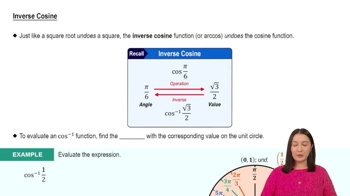
Inverse Cosine

Derivative of Inverse Functions

The derivative of an inverse function at a point relates to the derivative of the original function by the formula g'(y) = 1 / f'(x), where y = f(x). This relationship helps find the slope of the tangent line to the inverse function without explicitly differentiating it, provided f'(x) ≠ 0 at the point of interest.
Recommended video:
06:35
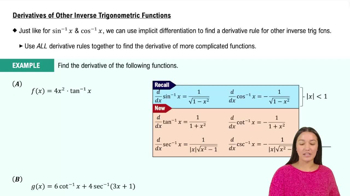
Derivatives of Other Inverse Trigonometric Functions

Tangent Line Approximation

Tangent line approximation uses the derivative at a point to approximate the function near that point with a linear function. For a function f at x₀, the tangent line is y = f(x₀) + f'(x₀)(x - x₀). This concept extends to inverse functions, allowing approximation of g(y) near y₀ using the slope of the inverse function.
Recommended video:
05:13
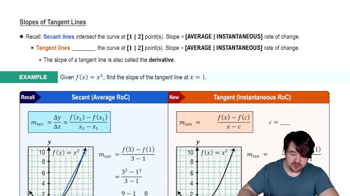
Slopes of Tangent Lines