
Ch. 10 - Infinite Sequences and Series
Hass - Thomas' Calculus 15th Edition
Hass15th EditionThomas' CalculusISBN: 9780137616077Not the one you use?Change textbook
Chapter 10, Problem 10.AAE.30b

30. b. By differentiating the series in part (a) term by term, show that
Σ(from n=1 to ∞) n / (n + 1)! = 1.

Verified step by step guidance
1
Recall the series from part (a), which is likely the sum of the reciprocals of factorials, such as \( \sum_{n=0}^\infty \frac{1}{n!} = e \). Identify the exact series given in part (a) to differentiate term by term.
Express the series \( \sum_{n=1}^\infty \frac{n}{(n+1)!} \) in a form that relates to the series from part (a). Notice that \( \frac{n}{(n+1)!} = \frac{n+1-1}{(n+1)!} = \frac{n+1}{(n+1)!} - \frac{1}{(n+1)!} = \frac{1}{n!} - \frac{1}{(n+1)!} \).
Rewrite the series using this decomposition: \( \sum_{n=1}^\infty \frac{n}{(n+1)!} = \sum_{n=1}^\infty \left( \frac{1}{n!} - \frac{1}{(n+1)!} \right) \).
Recognize that this is a telescoping series, where most terms cancel out when expanded. Write out the first few terms explicitly to see the cancellation pattern.
Sum the telescoping series by taking the limit as \( n \to \infty \) of the partial sums, and conclude that the sum converges to 1.

Verified video answer for a similar problem:

This video solution was recommended by our tutors as helpful for the problem above.
Video duration:
6m
Was this helpful?

Key Concepts

Here are the essential concepts you must grasp in order to answer the question correctly.

Term-by-Term Differentiation of Series

Term-by-term differentiation allows differentiating an infinite series by differentiating each term individually, provided the series converges uniformly. This technique is useful to find new series representations or to simplify expressions involving series.
Recommended video:
05:44
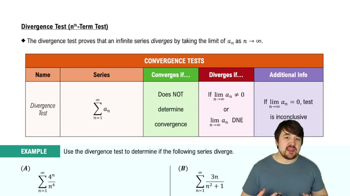
Divergence Test (nth Term Test)

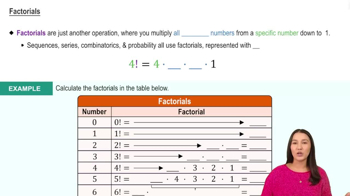
Factorials and Series Manipulation

Factorials (n!) grow rapidly and often appear in series expansions like those of exponential functions. Understanding how to manipulate terms involving factorials, such as rewriting n/(n+1)! as n!/(n+1)!, is key to simplifying and evaluating series.
Recommended video:
5:22
Factorials

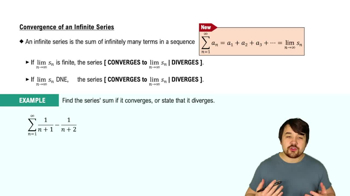
Convergence of Infinite Series

Determining whether an infinite series converges is essential before performing operations like differentiation term-by-term. Recognizing convergence ensures the validity of the manipulations and that the series sums to a finite value, such as the sum equaling 1 in this problem.
Recommended video:
06:52
Convergence of an Infinite Series