
Ch. 10 - Infinite Sequences and Series
Hass - Thomas' Calculus 15th Edition
Hass15th EditionThomas' CalculusISBN: 9780137616077Not the one you use?Change textbook
Chapter 10, Problem 10.PE.30

Determining Convergence of Series
Which of the series in Exercises 25–44 converge absolutely, which converge conditionally, and which diverge? Give reasons for your answers.


∑ (from n = 2 to ∞) 1/[n(ln n)²]

Verified step by step guidance
1
Identify the given series: \( \sum_{n=2}^{\infty} \frac{1}{n (\ln n)^2} \). We want to determine if it converges absolutely, conditionally, or diverges.
Since all terms \( \frac{1}{n (\ln n)^2} \) are positive for \( n \geq 2 \), absolute convergence is equivalent to convergence of the series itself.
Use the Integral Test to analyze convergence because the function \( f(x) = \frac{1}{x (\ln x)^2} \) is positive, continuous, and decreasing for \( x > 1 \).
Set up the integral \( \int_2^{\infty} \frac{1}{x (\ln x)^2} \, dx \). Use the substitution \( t = \ln x \), which implies \( dt = \frac{1}{x} dx \), so the integral becomes \( \int_{\ln 2}^{\infty} \frac{1}{t^2} \, dt \).
Evaluate the integral \( \int_{\ln 2}^{\infty} t^{-2} \, dt \) to determine if it converges. If the integral converges, then by the Integral Test, the series converges absolutely; if it diverges, the series diverges.

Verified video answer for a similar problem:

This video solution was recommended by our tutors as helpful for the problem above.
Video duration:
5m
Was this helpful?

Key Concepts

Here are the essential concepts you must grasp in order to answer the question correctly.

Absolute and Conditional Convergence

A series converges absolutely if the series of absolute values converges. If the original series converges but not absolutely, it is conditionally convergent. Understanding this distinction helps classify the behavior of series involving alternating or positive terms.
Recommended video:
07:51
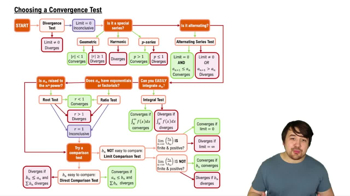
Choosing a Convergence Test

Integral Test for Convergence

The integral test compares a series to an improper integral of a related function. If the integral of f(x) from some point to infinity converges, then the series ∑ f(n) converges. This test is useful for series with terms like 1/[n(ln n)^p].
Recommended video:
07:51
Choosing a Convergence Test

Behavior of Logarithmic Functions in Series

Logarithmic terms in denominators affect convergence rates. For example, series with terms 1/[n(ln n)^p] converge or diverge depending on the exponent p. Recognizing how ln n influences the series is key to applying convergence tests correctly.
Recommended video:
5:26
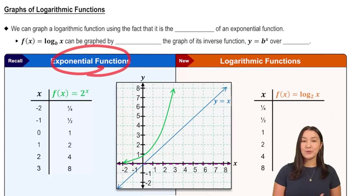
Graphs of Logarithmic Functions