
Textbook Question
Power Series
In Exercises 47–56, (a) find the series’ radius and interval of convergence. Then identify the values of x for which the series converges (b) absolutely and (c) conditionally.
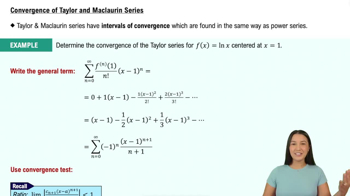
∑ (from n = 1 to ∞) (x + 4)ⁿ/(n3ⁿ)

 Verified step by step guidance
 08:26
08:26
 08:42
08:42 06:00
06:00Power Series
In Exercises 47–56, (a) find the series’ radius and interval of convergence. Then identify the values of x for which the series converges (b) absolutely and (c) conditionally.
∑ (from n = 1 to ∞) (x + 4)ⁿ/(n3ⁿ)
Convergent Series
Find the sums of the series in Exercises 19–24.
∑ (from n = 2 to ∞) -2/[n(n+1)]
Power Series
In Exercises 47–56, (a) find the series’ radius and interval of convergence. Then identify the values of x for which the series converges (b) absolutely and (c) conditionally.
∑ (from n = 1 to ∞) xⁿ/nⁿ
Power Series
In Exercises 47–56, (a) find the series’ radius and interval of convergence. Then identify the values of x for which the series converges (b) absolutely and (c) conditionally.
∑ (from n = 1 to ∞) (csch n)xⁿ
Determining Convergence of Sequences
Which of the sequences whose nth terms appear in Exercises 1–18 converge, and which diverge? Find the limit of each convergent sequence.
aₙ = 1 + (0.9)ⁿ
Determining Convergence of Series
Which of the series in Exercises 25–44 converge absolutely, which converge conditionally, and which diverge? Give reasons for your answers.
∑ (from n = 2 to ∞) 1/[n(ln n)²]