
Ch. 10 - Infinite Sequences and Series
Hass - Thomas' Calculus 15th Edition
Hass15th EditionThomas' CalculusISBN: 9780137616077Not the one you use?Change textbook
Chapter 10, Problem 10.PE.47

Power Series
In Exercises 47–56, (a) find the series’ radius and interval of convergence. Then identify the values of x for which the series converges (b) absolutely and (c) conditionally.


∑ (from n = 1 to ∞) (x + 4)ⁿ/(n3ⁿ)

Verified step by step guidance
1
Identify the given power series: \(\displaystyle \sum_{n=1}^{\infty} \frac{(x+4)^n}{n 3^n}\). Notice that this is a power series centered at \(x = -4\) because the term is \((x+4)^n\).
To find the radius of convergence, apply the Root Test or Ratio Test. The Ratio Test is often easier here. Consider the general term \(a_n = \frac{(x+4)^n}{n 3^n}\). Compute the limit \(L = \lim_{n \to \infty} \left| \frac{a_{n+1}}{a_n} \right|\).
Calculate the ratio inside the limit: \(\left| \frac{a_{n+1}}{a_n} \right| = \left| \frac{(x+4)^{n+1}}{(n+1) 3^{n+1}} \cdot \frac{n 3^n}{(x+4)^n} \right| = \left| \frac{(x+4)}{3} \cdot \frac{n}{n+1} \right|\). As \(n \to \infty\), \(\frac{n}{n+1} \to 1\), so the limit simplifies to \(L = \left| \frac{x+4}{3} \right|\).
The Ratio Test tells us the series converges if \(L < 1\), so the radius of convergence \(R\) satisfies \(\left| x+4 \right| < 3\). This means the radius of convergence is \(R = 3\), and the interval of convergence is \((-4 - 3, -4 + 3)\) or \((-7, -1)\), but we still need to check the endpoints \(x = -7\) and \(x = -1\) separately.
To determine convergence at the endpoints, substitute \(x = -7\) and \(x = -1\) into the series and analyze the resulting series. For each endpoint, check if the series converges absolutely (by testing the absolute value of terms) or conditionally (converges but not absolutely). This often involves comparing to known series like the p-series or alternating series tests.

Verified video answer for a similar problem:

This video solution was recommended by our tutors as helpful for the problem above.
Video duration:
13m
Was this helpful?

Key Concepts

Here are the essential concepts you must grasp in order to answer the question correctly.

Radius and Interval of Convergence

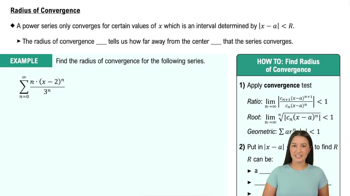
The radius of convergence is the distance from the center of a power series within which the series converges. The interval of convergence includes all x-values for which the series converges, possibly including endpoints. Finding these involves applying tests like the Ratio or Root Test to determine where the series converges absolutely.
Recommended video:
07:36
Radius of Convergence

Absolute Convergence

A series converges absolutely if the series of absolute values converges. This means ∑|a_n| converges, ensuring the original series converges regardless of sign changes. Absolute convergence guarantees stronger convergence properties and is often easier to test using comparison or ratio tests.
Recommended video:
07:51
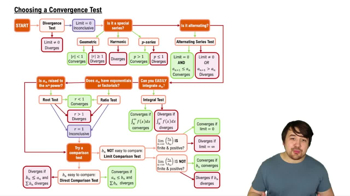
Choosing a Convergence Test

Conditional Convergence

Conditional convergence occurs when a series converges, but does not converge absolutely. This means the series ∑a_n converges, but ∑|a_n| diverges. Identifying conditional convergence often requires testing endpoints of the interval of convergence separately using tests like the Alternating Series Test.
Recommended video:
07:51
Choosing a Convergence Test