Ch. 7 - Transcendental Functions
Hass - Thomas' Calculus 15th Edition
Hass15th EditionThomas' CalculusISBN: 9780137616077Not the one you use?Change textbook
Chapter 7, Problem 7.5.78a

78. Which one is correct, and which one is wrong? Give reasons for your answers.
a. lim (x → 0) (x² - 2x) / (x² - sin x) = lim (x → 0) (2x - 2) / (2x - cos x) = lim (x → 0) 2 / (2 + sin x) = 2 / (2 + 0) = 1

Verified step by step guidance
1
Step 1: Identify the original limit expression: \(\lim_{x \to 0} \frac{x^{2} - 2x}{x^{2} - \sin x}\).
Step 2: Check if the limit can be directly substituted by plugging in \(x = 0\). If direct substitution leads to an indeterminate form like \(\frac{0}{0}\), then apply algebraic manipulation or L'Hôpital's Rule.
Step 3: The solution attempts to apply L'Hôpital's Rule by differentiating numerator and denominator separately. Differentiate numerator: \(\frac{d}{dx}(x^{2} - 2x) = 2x - 2\). Differentiate denominator: \(\frac{d}{dx}(x^{2} - \sin x) = 2x - \cos x\).
Step 4: Evaluate the new limit: \(\lim_{x \to 0} \frac{2x - 2}{2x - \cos x}\). Check if direct substitution is valid here. If it still results in an indeterminate form, consider applying L'Hôpital's Rule again or re-examining the differentiation.
Step 5: The next step in the problem shows a different limit: \(\lim_{x \to 0} \frac{2}{2 + \sin x}\), which does not follow from the previous step correctly. Verify the correctness of each differentiation and algebraic step to determine which parts are valid and which are not.

Verified video answer for a similar problem:

This video solution was recommended by our tutors as helpful for the problem above.
Video duration:
2m
Was this helpful?

Key Concepts

Here are the essential concepts you must grasp in order to answer the question correctly.

Limit of a Function

The limit of a function describes the value that the function approaches as the input approaches a particular point. It is fundamental in calculus for understanding behavior near points where the function may not be explicitly defined. Evaluating limits often involves direct substitution, simplification, or applying limit laws.
Recommended video:
06:11
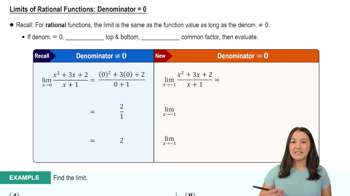
Limits of Rational Functions: Denominator = 0

L'Hôpital's Rule

L'Hôpital's Rule helps evaluate limits that result in indeterminate forms like 0/0 or ∞/∞ by differentiating the numerator and denominator separately. It requires checking that the original limit produces an indeterminate form before applying derivatives to find the limit more easily.
Recommended video:

Correct Application of Limit Operations

When manipulating limits, each step must preserve equivalence and be justified, such as valid algebraic simplifications or correct differentiation. Incorrect substitutions or misapplied rules can lead to wrong conclusions, so understanding when and how to apply limit properties is crucial.
Recommended video:
05:50
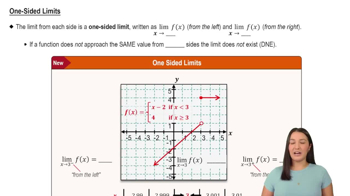
One-Sided Limits