Ch. 2 - Limits
Briggs - Calculus: Early Transcendentals 3rd Edition
Briggs3rd EditionCalculus: Early TranscendentalsISBN: 9780136847243Not the one you use?Change textbook
Chapter 2, Problem 53

Find the following limits or state that they do not exist. Assume a, b , c, and k are fixed real numbers.
lim h→0 (5 + h)^2 − 25 / h

Verified step by step guidance
1
Step 1: Recognize the form of the limit. This is a limit of the form \( \lim_{h \to 0} \frac{f(h)}{h} \), which suggests using algebraic manipulation to simplify.
Step 2: Expand the expression \((5 + h)^2\) using the binomial theorem or by direct multiplication: \((5 + h)^2 = 25 + 10h + h^2\).
Step 3: Substitute the expanded form back into the limit expression: \(\lim_{h \to 0} \frac{(25 + 10h + h^2) - 25}{h}\).
Step 4: Simplify the expression by canceling out terms: \(\lim_{h \to 0} \frac{10h + h^2}{h}\).
Step 5: Factor out \(h\) from the numerator: \(\lim_{h \to 0} \frac{h(10 + h)}{h}\), then cancel \(h\) from the numerator and denominator, and evaluate the limit as \(h\) approaches 0.

Verified video answer for a similar problem:

This video solution was recommended by our tutors as helpful for the problem above.
Video duration:
2m
Was this helpful?

Key Concepts

Here are the essential concepts you must grasp in order to answer the question correctly.

Limits

A limit is a fundamental concept in calculus that describes the behavior of a function as its input approaches a certain value. It helps in understanding how functions behave near specific points, which is crucial for defining derivatives and integrals. In this question, we are interested in the limit as h approaches 0, which will help us evaluate the expression given.
Recommended video:
05:50
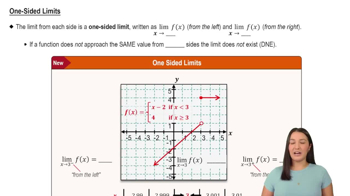
One-Sided Limits

Derivative

The derivative of a function at a point measures the rate at which the function's value changes as its input changes. It is defined as the limit of the average rate of change of the function over an interval as the interval shrinks to zero. The expression in the question resembles the definition of the derivative of the function f(h) = (5 + h)^2 at the point h = 0.
Recommended video:
05:44
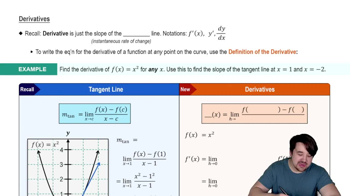
Derivatives

Algebraic Simplification

Algebraic simplification involves manipulating an expression to make it easier to evaluate or analyze. In the context of limits, this often includes factoring, expanding, or canceling terms to eliminate indeterminate forms. In this question, simplifying the expression (5 + h)^2 - 25 will be necessary to find the limit as h approaches 0.
Recommended video:
05:25
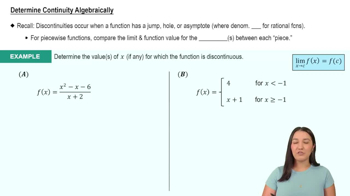
Determine Continuity Algebraically