Ch. 2 - Limits
Briggs - Calculus: Early Transcendentals 3rd Edition
Briggs3rd EditionCalculus: Early TranscendentalsISBN: 9780136847243Not the one you use?Change textbook
Chapter 2, Problem 53b

A function f is even if f(−x)=f(x), for all x in the domain of f. Suppose f is even, with lim x→2^+ f(x)=5 and lim x→2^− f(x)=8. Evaluate the following limits.
lim x→−2^− f(x)

Verified step by step guidance
1
Identify the property of even functions: An even function satisfies the condition f(-x) = f(x) for all x in its domain.
Given that f is even, we have f(-x) = f(x). Therefore, f(-2) = f(2).
Examine the given limits: \( \lim_{x \to 2^+} f(x) = 5 \) and \( \lim_{x \to 2^-} f(x) = 8 \).
Since f is even, the behavior of f around x = -2 will mirror the behavior around x = 2. Thus, \( \lim_{x \to -2^-} f(x) = \lim_{x \to 2^+} f(x) = 5 \).
Conclude that \( \lim_{x \to -2^-} f(x) = 5 \) based on the symmetry of even functions.

Verified video answer for a similar problem:

This video solution was recommended by our tutors as helpful for the problem above.
Video duration:
3m
Was this helpful?

Key Concepts

Here are the essential concepts you must grasp in order to answer the question correctly.

Even Functions

An even function is defined by the property that f(−x) = f(x) for all x in its domain. This symmetry about the y-axis implies that the function takes the same value for both positive and negative inputs of the same magnitude. Understanding this property is crucial for evaluating limits and determining function behavior around specific points.
Recommended video:
6:13
Exponential Functions

One-Sided Limits

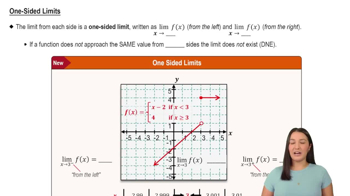
One-sided limits refer to the behavior of a function as it approaches a specific point from one side only, either the left (−) or the right (+). In this case, lim x→2^+ f(x) and lim x→2^− f(x) indicate the values of the function as x approaches 2 from the right and left, respectively. These limits help in understanding discontinuities and the overall behavior of the function near critical points.
Recommended video:
05:50
One-Sided Limits

Limit Evaluation at Symmetric Points

When dealing with even functions, the limits at symmetric points can be inferred from each other. For instance, if f is even and we know lim x→2^− f(x) = 8, we can deduce that lim x→−2^− f(x) will also equal 8, since f(−2) must equal f(2) due to the even property. This relationship simplifies the evaluation of limits for even functions.
Recommended video:
05:50
One-Sided Limits