Ch. 2 - Limits
Briggs - Calculus: Early Transcendentals 3rd Edition
Briggs3rd EditionCalculus: Early TranscendentalsISBN: 9780136847243Not the one you use?Change textbook
Chapter 2, Problem 51c

Analyze the following limits. Then sketch a graph of y=tanx with the window [−π,π]×[−10,10]and use your graph to check your work.
lim x→π/2^+ tan x

Verified step by step guidance
1
Step 1: Understand the behavior of the tangent function, \( y = \tan x \), near \( x = \frac{\pi}{2} \). The tangent function is undefined at \( x = \frac{\pi}{2} \) because it corresponds to a vertical asymptote.
Step 2: Consider the limit \( \lim_{x \to \frac{\pi}{2}^+} \tan x \). This means we are approaching \( \frac{\pi}{2} \) from the right side (values greater than \( \frac{\pi}{2} \)).
Step 3: As \( x \) approaches \( \frac{\pi}{2} \) from the right, the values of \( \tan x \) increase without bound. This is because the tangent function approaches positive infinity as it nears the vertical asymptote from the right.
Step 4: Sketch the graph of \( y = \tan x \) over the interval \([-\pi, \pi]\). Note the vertical asymptotes at \( x = -\frac{\pi}{2} \) and \( x = \frac{\pi}{2} \), and observe the behavior of the function as it approaches these asymptotes.
Step 5: Use the graph to verify that as \( x \to \frac{\pi}{2}^+ \), \( \tan x \to +\infty \). This confirms the behavior of the limit as described in the previous steps.

Verified video answer for a similar problem:

This video solution was recommended by our tutors as helpful for the problem above.
Video duration:
1m
Was this helpful?

Key Concepts

Here are the essential concepts you must grasp in order to answer the question correctly.

Limits

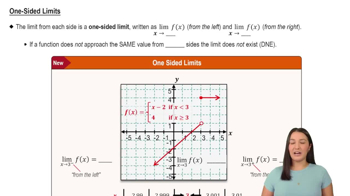
A limit is a fundamental concept in calculus that describes the behavior of a function as its input approaches a certain value. In this case, we are interested in the limit of the tangent function as x approaches π/2 from the right. Understanding limits helps in analyzing the continuity and behavior of functions, especially at points where they may not be defined.
Recommended video:
05:50
One-Sided Limits

Tangent Function

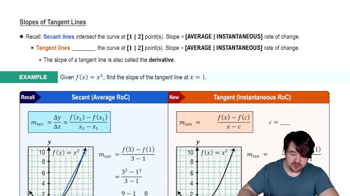
The tangent function, denoted as tan(x), is a periodic function defined as the ratio of the sine and cosine functions: tan(x) = sin(x)/cos(x). It has vertical asymptotes where the cosine function is zero, such as at x = π/2, leading to undefined values. Recognizing the properties of the tangent function is crucial for analyzing its limits and sketching its graph.
Recommended video:
05:13
Slopes of Tangent Lines

Graphing Functions

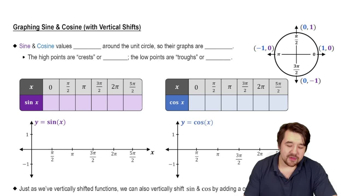
Graphing functions involves plotting points on a coordinate system to visualize the behavior of the function. For the tangent function, understanding its periodic nature and asymptotes is essential for accurate representation. By sketching the graph of y = tan(x) over the specified window, one can visually confirm the behavior of the function near the limit, enhancing comprehension of the limit's value.
Recommended video:
5:53
Graph of Sine and Cosine Function