Ch. 10 - Infinite Sequences and Series
Hass - Thomas' Calculus 15th Edition
Hass15th EditionThomas' CalculusISBN: 9780137616077Not the one you use?Change textbook
Chapter 10, Problem 10.7.36c

Intervals of Convergence
In Exercises 1–36, for what values of x does the series converge (c) conditionally?
∑ (from n = 1 to ∞) [ (√(n + 1) − √n)(x − 3)ⁿ ]

Verified step by step guidance
1
Identify the general term of the series: \[a_n = (\sqrt{n+1} - \sqrt{n})(x - 3)^n\].
Simplify the coefficient \[\sqrt{n+1} - \sqrt{n}\] by rationalizing the numerator: multiply numerator and denominator by \[\sqrt{n+1} + \sqrt{n}\] to get \[\frac{(n+1) - n}{\sqrt{n+1} + \sqrt{n}} = \frac{1}{\sqrt{n+1} + \sqrt{n}}\].
Rewrite the general term as \[a_n = \frac{(x - 3)^n}{\sqrt{n+1} + \sqrt{n}}\] and note that for large \[n\], \[\sqrt{n+1} + \sqrt{n} \approx 2\sqrt{n}\], so \[a_n \sim \frac{(x - 3)^n}{2\sqrt{n}}\].
Use the Root Test or Ratio Test to find the radius of convergence by focusing on the \[|x - 3|\] term, since the denominator grows like \[\sqrt{n}\] which affects convergence but not the radius directly.
Check convergence at the boundary points \[x = 3 \pm 1\] (assuming radius 1 from the test) by substituting these values into the series and analyzing whether the resulting series converges absolutely, conditionally, or diverges, using tests like the Alternating Series Test or p-series comparison.

Verified video answer for a similar problem:

This video solution was recommended by our tutors as helpful for the problem above.
Video duration:
8m
Was this helpful?

Key Concepts

Here are the essential concepts you must grasp in order to answer the question correctly.

Interval of Convergence

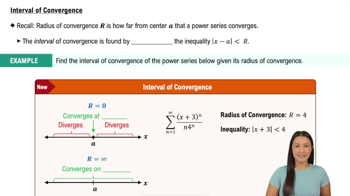
The interval of convergence is the set of all x-values for which a given power series converges. To find it, one typically uses the Ratio or Root Test to determine the radius of convergence, then checks the endpoints separately to see if the series converges there.
Recommended video:
08:44
Interval of Convergence

Conditional vs. Absolute Convergence

A series converges absolutely if the series of absolute values converges; otherwise, it may converge conditionally if the original series converges but not absolutely. Conditional convergence often occurs when terms alternate in sign or decrease slowly.
Recommended video:
07:51
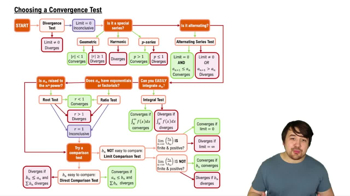
Choosing a Convergence Test

Behavior of the General Term and Limit Comparison

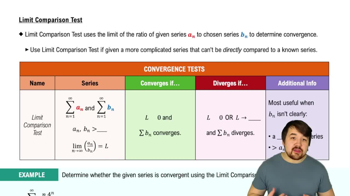
Analyzing the general term, especially expressions like (√(n+1) − √n), helps understand the series' behavior. Simplifying such terms and comparing them to known convergent or divergent series using limit comparison tests aids in determining convergence properties.
Recommended video:
07:45
Limit Comparison Test
Related Practice
Textbook Question

Intervals of Convergence

In Exercises 1–36, for what values of x does the series converge (c) conditionally?

∑ (from n = 0 to ∞) [ (−2)ⁿ (n + 1) (x − 1)ⁿ ]

Textbook Question

Intervals of Convergence

In Exercises 1–36, for what values of x does the series converge (c) conditionally?

∑ (from n = 1 to ∞) [ (3x + 1)^(n + 1) / (2n + 2) ]

Textbook Question

Assume that bₙ is a sequence of positive numbers converging to 4/5. Determine if the following series converge or diverge.

b. ∑ (from n = 1 to ∞) (5/4)ⁿ (bₙ)

1
views
Textbook Question

A sequence of rational numbers is described as follows:

1/1,3/2,7/5,17/12,…,a/b,(a + 2b)/(a + b),…

Here the numerators form one sequence, the denominators form a second sequence, and their ratios form a third sequence. Let xₙ and yₙ be, respectively, the numerator and the denominator of the nᵗʰ fraction rₙ = xₙ / yₙ.

b. The fractions rₙ = xₙ / yₙ approach a limit as n increases. What is that limit? (Hint: Use part (a) to show that rₙ² − 2 = ±(1 / yₙ)² and that yₙ is not less than n.)

1
views
Textbook Question

Assume that the series ∑ aₙxⁿ converges for x = 4 and diverges for x = 7. Answer true (T), false (F), or not enough information given (N) for the following statements about the series.

e. Diverges for x = 8

Textbook Question

Intervals of Convergence

Intervals of Convergence

In Exercises 1–36, for what values of x does the series converge (b) absolutely?

∑ (from n = 1 to ∞) [ (3x + 1)^(n + 1) / (2n + 2) ]