Ch. 10 - Infinite Sequences and Series
Hass - Thomas' Calculus 15th Edition
Hass15th EditionThomas' CalculusISBN: 9780137616077Not the one you use?Change textbook
Chapter 10, Problem 10.3.60b

Use the Cauchy condensation test from Exercise 59 to show that:
b. ∑ (from n=1 to ∞) [1 / nᵖ] converges if p > 1 and diverges if p ≤ 1.

Verified step by step guidance
1
Recall the Cauchy condensation test: For a non-increasing sequence of positive terms \(a_n\), the series \(\sum_{n=1}^\infty a_n\) converges if and only if the series \(\sum_{k=0}^\infty 2^k a_{2^k}\) converges.
Apply the test to the series \(\sum_{n=1}^\infty \frac{1}{n^p}\) by setting \(a_n = \frac{1}{n^p}\), which is positive and decreasing for \(p > 0\).
Form the condensed series: \(\sum_{k=0}^\infty 2^k a_{2^k} = \sum_{k=0}^\infty 2^k \cdot \frac{1}{(2^k)^p} = \sum_{k=0}^\infty 2^k \cdot 2^{-kp} = \sum_{k=0}^\infty 2^{k(1-p)}\).
Analyze the convergence of the geometric series \(\sum_{k=0}^\infty 2^{k(1-p)}\): it converges if and only if the common ratio \(r = 2^{1-p}\) satisfies \(|r| < 1\), which means \(1 - p < 0\) or \(p > 1\).
Conclude that by the Cauchy condensation test, the original series \(\sum_{n=1}^\infty \frac{1}{n^p}\) converges if \(p > 1\) and diverges if \(p \leq 1\).

Verified video answer for a similar problem:

This video solution was recommended by our tutors as helpful for the problem above.
Video duration:
4m
Was this helpful?

Key Concepts

Here are the essential concepts you must grasp in order to answer the question correctly.

Cauchy Condensation Test

The Cauchy condensation test is a method to determine the convergence of series with positive, non-increasing terms. It states that the series ∑a_n converges if and only if the condensed series ∑2^n a_{2^n} converges. This test simplifies analyzing series by focusing on terms at powers of two.
Recommended video:
4:22
Expand & Condense Log Expressions

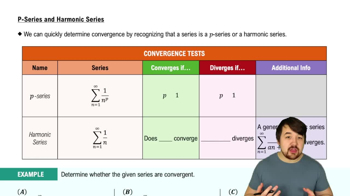
p-Series and Their Convergence

A p-series is a series of the form ∑1/n^p, where p is a real number. Its convergence depends on the value of p: the series converges if p > 1 and diverges if p ≤ 1. This result is fundamental in understanding the behavior of many infinite series.
Recommended video:
04:30
P-Series and Harmonic Series

Comparison of Series Using Condensation

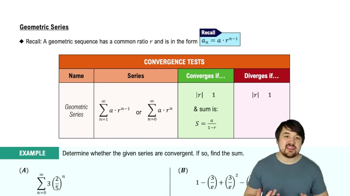
Applying the Cauchy condensation test to the p-series transforms it into a simpler geometric series ∑2^{n(1-p)}. Analyzing this geometric series helps determine convergence by comparing the exponent's sign, linking the original series' behavior to the parameter p.
Recommended video:
06:00
Geometric Series