
Textbook Question
Intervals of Convergence
In Exercises 1–36, for what values of x does the series converge (c) conditionally?
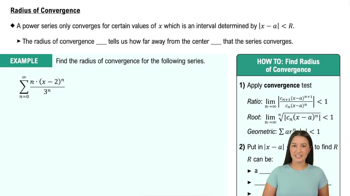
∑ (from n = 1 to ∞) [ (3x + 1)^(n + 1) / (2n + 2) ]

 Verified step by step guidance
 07:36
07:36
 06:52
06:52 07:45
07:45Intervals of Convergence
In Exercises 1–36, for what values of x does the series converge (c) conditionally?
∑ (from n = 1 to ∞) [ (3x + 1)^(n + 1) / (2n + 2) ]
b. From Example 5, Section 10.2, show that
S = 1 + ∑(from n=1 to ∞) [1 / (n²(n + 1))].
Assume that bₙ is a sequence of positive numbers converging to 4/5. Determine if the following series converge or diverge.
b. ∑ (from n = 1 to ∞) (5/4)ⁿ (bₙ)
A sequence of rational numbers is described as follows:
1/1,3/2,7/5,17/12,…,a/b,(a + 2b)/(a + b),…
Here the numerators form one sequence, the denominators form a second sequence, and their ratios form a third sequence. Let xₙ and yₙ be, respectively, the numerator and the denominator of the nᵗʰ fraction rₙ = xₙ / yₙ.
b. The fractions rₙ = xₙ / yₙ approach a limit as n increases. What is that limit? (Hint: Use part (a) to show that rₙ² − 2 = ±(1 / yₙ)² and that yₙ is not less than n.)
Use the Cauchy condensation test from Exercise 59 to show that:
b. ∑ (from n=1 to ∞) [1 / nᵖ] converges if p > 1 and diverges if p ≤ 1.
Intervals of Convergence
Intervals of Convergence
In Exercises 1–36, for what values of x does the series converge (b) absolutely?
∑ (from n = 1 to ∞) [ (3x + 1)^(n + 1) / (2n + 2) ]