
Textbook Question
Assume that the series ∑ aₙ(x − 2)ⁿ converges for x = −1 and diverges for x = 6. Answer true (T), false (F), or not enough information given (N) for the following statements about the series.
f. Diverges for x = 4.9

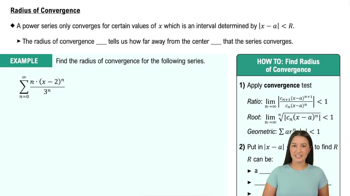
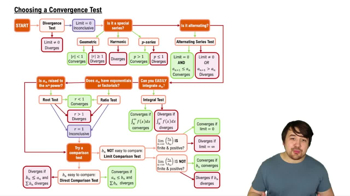
 Verified step by step guidance
 07:36
07:36
 07:51
07:51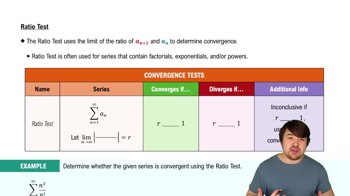 05:35
05:35Assume that the series ∑ aₙ(x − 2)ⁿ converges for x = −1 and diverges for x = 6. Answer true (T), false (F), or not enough information given (N) for the following statements about the series.
f. Diverges for x = 4.9
Intervals of Convergence
In Exercises 1–36, for what values of x does the series converge (c) conditionally?
∑ (from n = 1 to ∞) [ (3x + 1)^(n + 1) / (2n + 2) ]
Assume that the series ∑ aₙxⁿ converges for x = 4 and diverges for x = 7. Answer true (T), false (F), or not enough information given (N) for the following statements about the series.
e. Diverges for x = 8
Intervals of Convergence
In Exercises 1–36, for what values of x does the series converge (c) conditionally?
∑ (from n = 1 to ∞) [ (√(n + 1) − √n)(x − 3)ⁿ ]
Intervals of Convergence
Intervals of Convergence
In Exercises 1–36, for what values of x does the series converge (b) absolutely?
∑ (from n = 1 to ∞) [ (3x + 1)^(n + 1) / (2n + 2) ]