
Ch. 7 - Logarithmic, Exponential Functions, and Hyperbolic Functions
Briggs - Calculus: Early Transcendentals 3rd Edition
Briggs3rd EditionCalculus: Early TranscendentalsISBN: 9780136847243Not the one you use?Change textbook
Chapter 7, Problem 7.1.67b

Explain why or why not Determine whether the following statements are true and give an explanation or counterexample. Assume x > 0 and y > 0.


b. ln 0 = 1

Verified step by step guidance
1
Recall the definition of the natural logarithm function: \(\ln x\) is the inverse of the exponential function \(e^x\), meaning \(\ln x = y\) if and only if \(e^y = x\).
Consider the value \(\ln 0\). To find this, we ask: for what value of \(y\) does \(e^y = 0\) hold true?
Since the exponential function \(e^y\) is always positive for all real numbers \(y\) (i.e., \(e^y > 0\) for all \(y\)), it never equals zero.
Therefore, there is no real number \(y\) such that \(e^y = 0\), which means \(\ln 0\) is undefined and does not equal 1 or any other real number.
In conclusion, the statement \(\ln 0 = 1\) is false because \(\ln 0\) is not defined in the real numbers.

Verified video answer for a similar problem:

This video solution was recommended by our tutors as helpful for the problem above.
Video duration:
1m
Was this helpful?

Key Concepts

Here are the essential concepts you must grasp in order to answer the question correctly.

Definition and Domain of the Natural Logarithm Function

The natural logarithm function, ln(x), is defined only for positive real numbers (x > 0). It represents the inverse of the exponential function e^x, meaning ln(x) answers the question: 'To what power must e be raised to get x?' Since 0 is not positive, ln(0) is undefined.
Recommended video:
05:18
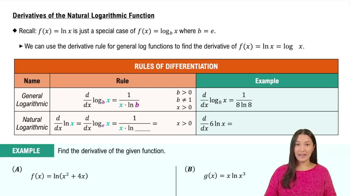
Derivative of the Natural Logarithmic Function

Behavior of ln(x) as x Approaches Zero

As x approaches 0 from the positive side, ln(x) decreases without bound, tending toward negative infinity. This means ln(0) is not a finite number and certainly not equal to 1. Understanding this limit helps clarify why ln(0) is undefined.
Recommended video:
05:36
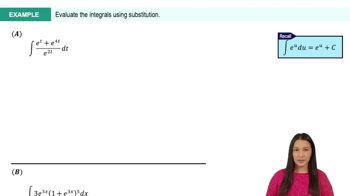
Integrals of Natural Exponential Functions (e^x) Example 3

Evaluating the Truth of Mathematical Statements

To determine if a statement like 'ln 0 = 1' is true, one must check the domain and properties of the functions involved. Since ln(0) is undefined, the statement is false. Providing a counterexample or referencing the function's domain is essential in justifying such claims.
Recommended video:
5:14
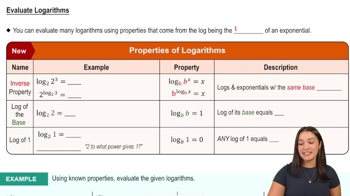
Evaluate Logarithms
Related Practice
Textbook Question

Oil consumption Starting in 2018 (t=0), the rate at which oil is consumed by a small country increases at a rate of 1.5%/yr, starting with an initial rate of 1.2 million barrels/yr.


b. Find the function that gives the amount of oil consumed between t=0 and any future time t.

Textbook Question

Energy consumption On the first day of the year (t=0), a city uses electricity at a rate of 2000 MW. That rate is projected to increase at a rate of 1.3% per year.


b. Find the total energy (in MW-yr) used by the city over four full years beginning at t=0.

Textbook Question

Theorem 7.8

Differentiate sinh⁻¹ x = ln (x + √(x² + 1)) to show that d/dx (sinh⁻¹ x) = 1 / √(x² + 1).

Textbook Question

Overtaking City A has a current population of 500,000 people and grows at a rate of 3%/yr. City B has a current population of 300,000 and grows at a rate of 5%/yr.

b. Suppose City C has a current population of y₀ < 500,000 and a growth rate of p > 3%/yr. What is the relationship between y₀ and p such that Cities A and C have the same population in 10 years?

Textbook Question

61–62. Points of intersection and area

b. Compute the area of the region described.


f(x) = sinh x, g(x) = tanh x; the region bounded by the graphs of f, g, and x = ln 3

1
views
Textbook Question

A running model A model for the startup of a runner in a short race results in the velocity function v(t) = a(1 - e⁻ᵗ/ᶜ), where a and c are positive constants, t is measured in seconds, and v has units of m/s. (Source: Joe Keller, A Theory of Competitive Running, Physics Today, 26, Sep 1973)


b. Using the velocity in part (a) and assuming s(0) = 0, find the position function s(t), for t ≥ 0.