Ch. 7 - Logarithmic, Exponential Functions, and Hyperbolic Functions
Briggs - Calculus: Early Transcendentals 3rd Edition
Briggs3rd EditionCalculus: Early TranscendentalsISBN: 9780136847243Not the one you use?Change textbook
Chapter 7, Problem 7.2.24b

Energy consumption On the first day of the year (t=0), a city uses electricity at a rate of 2000 MW. That rate is projected to increase at a rate of 1.3% per year.


b. Find the total energy (in MW-yr) used by the city over four full years beginning at t=0.

Verified step by step guidance
1
Identify the given information: the initial rate of electricity consumption at time \(t=0\) is \(R_0 = 2000\) MW, and the rate increases at a rate of 1.3% per year. This means the rate of consumption grows exponentially.
Express the rate of electricity consumption as a function of time \(t\) (in years). Since the rate increases by 1.3% per year, the rate function is \(R(t) = 2000 \times (1.013)^t\) MW.
To find the total energy used over four years, we need to integrate the rate function over the interval from \(t=0\) to \(t=4\). The total energy \(E\) is given by the integral \(E = \int_0^4 R(t) \, dt = \int_0^4 2000 \times (1.013)^t \, dt\).
Set up the integral for the exponential function. Recall that the integral of \(a^t\) with respect to \(t\) is \(\frac{a^t}{\ln(a)}\), where \(a > 0\) and \(a \neq 1\). So, the integral becomes \(2000 \times \int_0^4 (1.013)^t \, dt = 2000 \times \left[ \frac{(1.013)^t}{\ln(1.013)} \right]_0^4\).
Evaluate the definite integral by substituting the limits \(t=4\) and \(t=0\) into the antiderivative expression, then subtract the lower limit value from the upper limit value to find the total energy consumed over the four years.

Verified video answer for a similar problem:

This video solution was recommended by our tutors as helpful for the problem above.
Video duration:
8m
Was this helpful?

Key Concepts

Here are the essential concepts you must grasp in order to answer the question correctly.

Exponential Growth

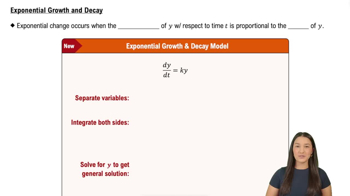
Exponential growth describes a quantity that increases at a rate proportional to its current value. In this problem, the electricity usage rate grows by 1.3% per year, meaning the rate at time t can be modeled as an exponential function, R(t) = R_0 * e^(kt), where k is the growth rate.
Recommended video:
09:29
Exponential Growth & Decay

Integration to Find Total Accumulated Quantity

To find the total energy used over a time interval, we integrate the rate function over that period. Integration sums the instantaneous rates over time, giving the total accumulated energy consumption in MW-years.
Recommended video:
09:15
Tabular Integration by Parts Example 6

Converting Percentage Growth to Continuous Growth Rate

A percentage growth rate given per year (1.3%) can be converted to a continuous growth rate k by using k = ln(1 + r), where r is the decimal form of the percentage. This allows modeling the growth with the exponential function e^(kt) for continuous compounding.
Recommended video:
09:29
Exponential Growth & Decay
Related Practice
Textbook Question

Oil consumption Starting in 2018 (t=0), the rate at which oil is consumed by a small country increases at a rate of 1.5%/yr, starting with an initial rate of 1.2 million barrels/yr.


b. Find the function that gives the amount of oil consumed between t=0 and any future time t.

Textbook Question

37–38. Caffeine After an individual drinks a beverage containing caffeine, the amount of caffeine in the bloodstream can be modeled by an exponential decay function, with a half-life that depends on several factors, including age and body weight. For the sake of simplicity, assume the caffeine in the following drinks immediately enters the bloodstream upon consumption.


An individual consumes two cups of coffee, each containing 90 mg of caffeine, two hours apart. Assume the half-life of caffeine for this individual is 5.7 hours.


b. Determine the amount of caffeine in the bloodstream 1 hour after drinking the second cup of coffee.

Textbook Question

Overtaking City A has a current population of 500,000 people and grows at a rate of 3%/yr. City B has a current population of 300,000 and grows at a rate of 5%/yr.

b. Suppose City C has a current population of y₀ < 500,000 and a growth rate of p > 3%/yr. What is the relationship between y₀ and p such that Cities A and C have the same population in 10 years?

Textbook Question

Explain why or why not Determine whether the following statements are true and give an explanation or counterexample. Assume x > 0 and y > 0.


b. ln 0 = 1

Textbook Question

61–62. Points of intersection and area

b. Compute the area of the region described.


f(x) = sinh x, g(x) = tanh x; the region bounded by the graphs of f, g, and x = ln 3

1
views
Textbook Question

A slowing race Starting at the same time and place, Abe and Bob race, running at velocities u(t) = 4 / (t + 1) mi/hr and v(t) = 4e^(−t/2) mi/hr, respectively, for t ≥ 0.

b. Find and graph the position functions of both runners. Which runner can run only a finite distance in an unlimited amount of time?