
Ch. 7 - Logarithmic, Exponential Functions, and Hyperbolic Functions
Briggs - Calculus: Early Transcendentals 3rd Edition
Briggs3rd EditionCalculus: Early TranscendentalsISBN: 9780136847243Not the one you use?Change textbook
Chapter 7, Problem 7.3.38b

37–38. Caffeine After an individual drinks a beverage containing caffeine, the amount of caffeine in the bloodstream can be modeled by an exponential decay function, with a half-life that depends on several factors, including age and body weight. For the sake of simplicity, assume the caffeine in the following drinks immediately enters the bloodstream upon consumption.


An individual consumes two cups of coffee, each containing 90 mg of caffeine, two hours apart. Assume the half-life of caffeine for this individual is 5.7 hours.


b. Determine the amount of caffeine in the bloodstream 1 hour after drinking the second cup of coffee.

Verified step by step guidance
1
Identify the exponential decay model for caffeine amount: the amount remaining after time \(t\) hours is given by \(A(t) = A_0 \times \left(\frac{1}{2}\right)^{\frac{t}{h}}\), where \(A_0\) is the initial amount of caffeine, and \(h\) is the half-life (5.7 hours in this case).
Calculate the amount of caffeine remaining from the first cup 3 hours after consumption, since the second cup is consumed 2 hours after the first, and we want the amount 1 hour after the second cup (total 2 + 1 = 3 hours after the first cup). Use \(t=3\) hours for the first cup.
Calculate the amount of caffeine remaining from the second cup 1 hour after consumption, so use \(t=1\) hour for the second cup.
Add the amounts of caffeine remaining from both cups at the 1 hour mark after the second cup to find the total caffeine in the bloodstream at that time.
Express the total caffeine amount as \(A_{total} = 90 \times \left(\frac{1}{2}\right)^{\frac{3}{5.7}} + 90 \times \left(\frac{1}{2}\right)^{\frac{1}{5.7}}\) without calculating the numerical value.

Verified video answer for a similar problem:

This video solution was recommended by our tutors as helpful for the problem above.
Video duration:
5m
Was this helpful?

Key Concepts

Here are the essential concepts you must grasp in order to answer the question correctly.

Exponential Decay Function

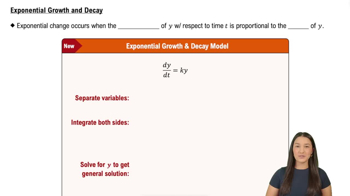
Exponential decay describes processes where quantities decrease at rates proportional to their current value. In this context, caffeine concentration decreases over time following the formula A(t) = A_0 * (1/2)^(t/h), where A_0 is the initial amount, t is time elapsed, and h is the half-life.
Recommended video:
09:29
Exponential Growth & Decay

Half-Life

Half-life is the time required for a substance to reduce to half its initial amount. For caffeine, it indicates how quickly the body metabolizes it. Knowing the half-life allows calculation of remaining caffeine after any time period using exponential decay.
Recommended video:
6:32
Finding Global Extrema (Extreme Value Theorem) Example 3

Superposition of Multiple Doses

When multiple doses are taken at different times, the total amount in the bloodstream is the sum of the remaining amounts from each dose. Each dose decays independently according to the exponential decay model, and their contributions must be added to find the total caffeine level.
Recommended video:
4:22
Expand & Condense Log Expressions